Back to Blog

It is precisely a year since my last blog post, which I guess makes this both my first and last blog of 2024. It’s not a year I will regret seeing the back of. I spent the first three months of the year caring for my wife, Dejanka, as the lung cancer which we thought she had beaten metastasised to her brain in such a virulent form that her decline was rapid and she passed away in our local hospice in April. Thankfully, our learning-disabled daughter, Hanna, was away in college at the time, but she finished her course in July and I spent the following months caring for her while arranging for her to move into supported living, which happened towards the end of September.

As a result of all this, I watched very little TV in the first two thirds of the year. It was not just that I had so much to do in terms of the administrative fallout from my wife’s death and the requirements of securing Hanna’s future (as well as the ongoing responsibility for my 98 year-old mother), but my heart was just not in it. I tended to catch just what I knew would particularly interest or distract me, while also seeking refuge in music.

However, now that I am alone and a lot of the things I had to do have been done, I have more recently returned to filling my time (and distracting myself from grief) with reading, working my way through my extensive DVD and blu-ray collections, attending concerts, theatre and football matches and, of course, watching TV and catching up on some of the things which had passed me by earlier in the year. And now I have finally returned to the blogging keypad, just in time for an end-of-year summary and list.

My lists of recent years had already been (as I have admitted) somewhat incomplete, due to the fact that there is just too much to watch and I do not subscribe to a number of streaming platforms, so this year’s is particularly sketchy. To tell the truth, I had already begun to wonder whether my selections of current TV were of any interest anymore and was on the verge of giving them up and concentrating on TV and films from the past as I go through it and re-introduce myself to much of it. I was certainly getting the feeling that I was becoming more and more out of touch with changing styles and concerns and that, while I could still recognise innovation, I was often simply not getting the references that have been so vital to understanding the subtleties of the greatest work. I have never been one to believe that things were better in the “good old days”. Things do not get either better or worse in pretty much any aspect of life, they just get different and there comes a time when it is best to recognise the fading of one’s ability (or desire) to keep up.

However, one of the books I read in the course of the year had an impact on my thinking in this regard. Peter Biskind’s Pandora’s Box: the Greed, Lust, and Lies that Broke Television (Allen Lane, 2023) is a good survey of the changes in TV styles (at least in terms of US drama) in this century, driven by the expansion of subscription services. Towards the end of the book, his narrative seemed to be running out of steam as he described the current ongoing situation without an apparent resolution but his final section, entitled Back to the Future, posited the idea that TV, including the streaming services, is returning to more linear and family-friendly programming such as the old networks used to provide. He cites shows such as Ted Lasso and the re-appearance of old-style “mystery of the week” dramas. I read this chapter just as the entertaining Ludwig arrived on BBC1, so it certainly seemed to me to be a possibility. It also fits with my own outmoded preference, to which I stubbornly adhere, for watching episodes of series at the time they are scheduled each week (or catching up on them retrospectively), rather than binging them in advance if they are made available on i-Player or whatever.  

So, I’ll see how things develop over the next year and work out as I go when I want to comment on current output, while at the same time looking back and compiling the inevitable lists. In the meantime, let’s look back on the departing year and give you a tentative list of my ten favourite things, rather than a ten “best”.

I certainly watched a number of second series of things I had previously praised highly with great anticipation and found them worth watching, though not as impactful as the original. Blue Lights (BBC1) put me off from the start by (yet again!) presenting a perilous police situation which turned out to be an exercise (yawn!). It was an engaging watch, but not up to the previous series. The same went for Sherwood (BBC1), which worked as a terrific thriller, but was not as wonderfully grounded in social comment as before (as I had feared would happen when, in my previous blog on the show, I had hoped there would not be a second series because it could only lessen the impact of the original). The best thing about the second series was Monica Dolan, who had begun the year as the most sympathetic victim of the Post Office scandal and then transformed herself into an ice-cold killer. In reality TV, my favourite was still The Piano (Channel 4), which contained more moving characters and stories but nothing quite as remarkable as Lucy. 

The second series of Colin from Accounts (BBC2), on the other hand, was just as wonderful as the first and then along came Wolf Hall (BBC1), undoubtedly my most anticipated thing of this (and many another) year. Picking up where it left off almost a decade ago, it was always going to be my top pick of the year however long we had waited. Was there ever any doubt that the second panel of the diptych would be the magnificent equal of the first? It’s arguably the BBC’s finest contribution to drama this century and the Corporation showed its respect for this status by granting it the rare honour of not interrupting the closing credits of the final episode (though, of course, you could only appreciate this moment if you watched the scheduled transmission).

So, my top ten favourites for 2024 are as follows:

In drama, I have already signalled Wolf Hall: the Mirror and the Light (BBC1) as my top pick. Going back to the very first week of the year, before things started to get difficult, Mr Bates vs the Post Office (ITV) provided the year’s most discussed and impactful piece. I caught up with the gripping Baby Reindeer (Netflix) much later than everybody else, while I was hooked to The Day of the Jackal (Sky Atlantic) as soon as it went out. Created and written by Ronan Bennett, who gave us Top Boy, The Day of the Jackal had all of that series’ tension, action sequences, depth and moral ambiguity.

My favourite documentaries of the year were D-Day: The Unheard Tapes (BBC2), which used archived audio interviews of participants to great effect and The Zelensky Story (BBC2), which contained a wealth of fascinating and surprising visual resources as well as the key interviewees.

The second series of Colin from Accounts (BBC2) lived up to the promise of the first and will hopefully continue to keep us coming back for more in future years.

Finally, three of my very favourite series managed to wrap up their runs with wonderful final seasons, all culminating in unmissable, perfectly judged and brilliantly self-referential finales: Inside No.9 (series 9, of course: BBC2), Curb Your Enthusiasm (series 12!: HBO, Sky Comedy) and How To With John Wilson (series 3, the perfect number: HBO, BBC2).

So, that just leaves me to say Happy New Year to everybody and heartfelt thanks to those whose kindness and support saw me though this most difficult of years.

At the Last Minute

In yesterday’s blog, I shared my 12-title shortlist for my 2023 top 10, which I presented as my final reckoning “barring any last-minute revelations”. Well, guess what? At the last minute, I have another title to add to the list. It is not something I saw on TV in the last 24 hours, but a series from earlier in the year which I was catching up with on BBC i-player on a trusted friend’s recommendation and have noticed appearing in the “best of year” lists. I had already seen 4 episodes and thought it was pretty good (I was still watching, after all) but the terrific last two episodes raised it to shortlist status, so I need to start this blog with a brief reaction before giving you my top 10 of the year.

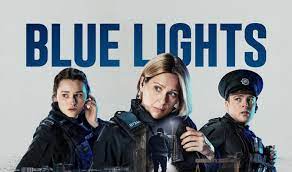
Blue Lights (BBC1) follows three new recruits to the Belfast police and features a main storyline involving intelligence agencies, a drugs gang and the legacy of the Troubles. This would make it interesting enough, but it is the general ambience of the piece which most caught my attention. British TV spent much of the 80s and 90s trying to create a cop show which could replicate the success of Hill Street Blues and failed miserably. But this reminded me most of that seminal series. It is only a six-parter, but it quickly established the camaraderie, the patrol-car teams, the briefings at base, the romances and the background air of threat which were staples of Hill Street. And, like Hill Street, it had the sudden plot-shifting potential of gun violence which had not really been possible in previous British cop series. All was very neatly set up for a second series and I suspect it will run and run.

So, with this added to yesterday’s shortlist to make 13, here are my top 10 selections for 2023:

Happy Valley (BBC1)

The excellent third series wrapping up the saga and standing for the whole.

Three Minutes – a Lengthening (BBC4)

A riveting and moving forensic examination of a fragment of archival footage.

Best Interests (BBC1)

Jack Thorne’s latest phenomenal 4-parter, with Sharon Horgan and Michael Sheen on top form.

There She Goes (BBC2)

A superb and moving special to conclude Rosie’s story, though I’d still like to see it back some time.

The Piano (Channel 4)

Wonderful human stories and great musical performances in the most enjoyable reality show I have ever seen.

Colin From Accounts (BBC2)

Blunt Aussie humour combined with terrific performances from the husband-and-wife team of Harriet Dyer and Patrick Brammall.

Once Upon a Time in Northern Ireland (BBC2)

Revelatory documentary series about the Troubles in Northern Ireland, with witnesses only now able to speak about it.

The Long Shadow (ITV)

Sensitive dramatic exploration of the effect of the Yorkshire Ripper’s crimes in the 1970s and the police failure to apprehend him.

Boiling Point (BBC1)

A brilliant film transformed into an even more intense 4-part series.

Blue Lights (BBC1)

See above

My choice for best thing of the year would be Best Interests, which I hinted at in yesterday’s blog, while bemoaning its complete absence from the Guardian’s top 50 of the year. 

All my picks come from traditional broadcast TV this year. As before, there was plenty I missed from the streaming platforms, but what I did watch seemed to me to be becoming repetitive and unoriginal. Maybe there will be something more inspiring from them in 2024. Let’s hope so and Happy New Year.

Reckoning Time

Yet again, I have left too long between blogs, so this one will serve to catch up with (some of) the TV I have watched since my last blog on the subject and complete the shortlist for my 2023 best 10 before the end of the year.

The autumn brought four dramas of significance for consideration. By a strange coincidence, Monday nights at 9pm saw simultaneous transmissions of difficult dramatisations of the crimes of two British predatory monsters of the 1970s. BBC1 had its long-awaited dramatic confrontation with the legacy of the Jimmy Savile scandal in the form of the 4-part The Reckoning. I guess this was something the Corporation felt it had to do, but I suspect many viewers tuned in to see how they negotiated the multiple pitfalls the project entailed rather than to learn anything new about the Savile scandal itself. I certainly did and that was enough to keep me watching, though ultimately I wondered what it had achieved beyond the exorcism of collective guilt. The makers clearly were desperate to avoid “humanising” Savile in any way at all and achieved that end, though at the expense of giving Steve Coogan anything really interesting to work with. His performance was excellent in the circumstances, but ultimately was as much an impression as it was acting, which is probably the reason he was chosen to do it.

Over on ITV, the seven-part The Long Shadow revisited the crimes of the Yorkshire Ripper and solved the problem of not humanising Peter Sutcliffe by barely showing him at all. Instead, he was an unseen menace and the drama concentrated on the effect of his monstrous crimes on his victims, their families and the few who survived his attacks, and on the multiple failures of the police investigation, especially how DCS George Oldfield (David Morrisey) became so obsessed with the hoax tape that vital leads which could have caught the murderer earlier were not followed up. As a result, the series worked extremely well in terms of dramatic tension and period reconstruction and negotiated the potential pitfalls of its subject matter deftly. The recreation of the feel of the 1970s was one of the most impressive I have seen in a drama and the cast was uniformly excellent. It makes my shortlist, but The Reckoning doesn’t.

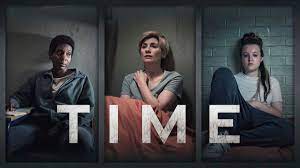
Two years ago, Stephen Graham starred in Jimmy McGovern’s Time (BBC1) and the film Boiling Point. This year, he was back in the four-part TV continuation of Boiling Point, while Time was back for a second season, though this time without him. One of the key features of the film of Boiling Point was that it was shot in one continuous take, which gave it a breathless intensity. Director Philip Barantini manged to recreate that intensity for the series, though with some conventional editing this time. We also saw the characters outside the confines of the restaurant they work at and their storylines piled personal pressures on all of them to add to that of the workplace. It was mostly pretty hectic, though with some occasional still moments for welcome contrast. The hour-long episodes simply flew by, which is always a good sign, and the cast was uniformly top notch, led by Vinette Robinson, with a reduced but telling presence from Graham and a welcome appearance from Cathy Tyson.

The second season of Time was written by McGovern and Helen Black and set in a women’s prison. With three main characters, each with their own complex storyline, it didn’t have quite the same impact as the first season, but was still a compelling piece of work. Ultimately, it didn’t quite have enough to make my shortlist, but Boiling Point does.

More recently I have caught up with some favourites on streaming services, most notably the final series of Top Boy, which was excellent and provided a fitting finale to an outstanding series, though without improving on what had gone before, and the fifth series of Fargo, which represents a return to previous form after the disappointment of season four, though at the time of writing the series remains unfinished, so neither qualifies for my shortlist.

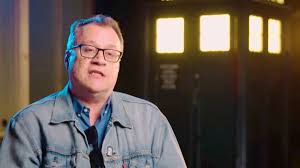
The return of Doctor Who is always interesting, especially so this time with the return of David Tennant and Catherine Tate, the best Doctor/companion combination of the modern era, for three specials as an interim between the Whittaker and Gatwa eras, a development presumably designed by returning showrunner Russell T. Davies to keep the traditional fan base on board in a time of radical change for the show. The third special ended not with the expected regeneration scene, but the new twist of a “bi-generation” which left both the old and new doctor in simultaneous existence and, crucially, both with their own TARDIS. Although Tennant’s doctor was shown “in retirement” critics were not slow to wonder aloud if this device was introduced to give the option of bringing him back (again!) if Gatwa’s incarnation is not a success. I have a different concern about it: I worry that it will be a future plot device to get the Doctor out of a seemingly impossible situation by having an earlier one arrive in his/her/their own TARDIS in the nick of time. This could get very tiresome, much as the “I went back in time and made an adjustment” get-out did. Incidentally, have you noticed how often companions fret about their families waiting for them back home, but the Doctor never says “don’t worry, we’ll be going back to precisely the time when you left them when this adventure is over”. Ncuti Gatwa’s first full episode was a bit silly, especially the musical number, but it was a Christmas Day special, so not something by which the new era should be judged.

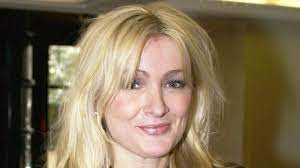
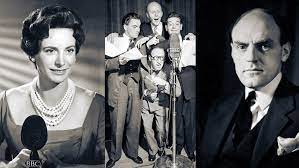
The return of the Doctor with Davies in charge was marked by an Imagine special which did a thorough job of examining and assessing Davies’ highly impressive writing and producing career to date. Over Christmas, we got two more similar documentaries, both about significant female comic talents who emerged in the 1990s. On Christmas Day, BBC2 gave us a full evening devoted to the career of the late Caroline Aherne, the centrepiece of which was an Arena special on her life and work (illustrated either side by some brilliantly chosen examples of her best shows, mostly Christmas themed). The Arena itself perfectly encapsulated why she was so significant and so well-loved by all her associates, but was also frustratingly incomplete. There was no mention of her turbulent marriage to the rock musician Peter Hook (and she was, indeed, credited as Caroline Hook in the earliest episodes of The Mrs Merton Show). More frustratingly, there was also no mention of the single series of the sitcom Mrs Merton and Malcolm, which she created with Craig Cash. I regard this as one of the great “lost” comedies of British television. Time Out described it as “possibly the most disturbing show on British television” and the general response was one of misunderstanding and rejection. But whether you like it or not, there is no getting away from its significance to the Caroline Aherne story and its omission from consideration keeps the otherwise excellent Arena special off my shortlist.

The second special, on BBC1 the day after Boxing Day, was another Imagine in which Alan Yentob considered the careers of French and Saunders, both as a double act and in their individual projects. With an extended length, this was another thorough and enjoyable trawl though a wealth of outstanding material. Watching both specials gave me a great sense of the significance of the talents under considerations. Outstanding talent gets an Imagine special on BBC1. Genius gets an Arena special on BBC2.

And so back to my shortlist for the best of 2023. Having left it late to finish compiling my list I have been able to look, as I always do, at the major listings which appear at this time of the year and see where my own favourites feature. The most significant countdown is that produced by The Guardian, which reveals the top picks of their top 50 on a daily basis in the run-up to Christmas, with links to their original reviews. A number of my picks featured at various stages of the countdown, but my very favourite thing had not turned up when we got to the top three. I was pleased it would surely feature so high, maybe even at the top, but three, two and one were revealed and it was not there! Not in the top 50 at all! What had gone wrong? I revisited the Guardian’s original review, by Lucy Mangan, who had given it five stars and described it as “masterly and profoundly moving”. For comparison, I checked a couple of other picks on my shortlist, which had featured on the Guardian list at numbers 34 and 24 and followed the links to positive, but four star reviews from Mangan and Rebecca Nicholson. Time, which I considered above, made number 23 on the Guardian list, but again only got four stars from Mangan. So how does that work? Was the Guardian’s top 50 list written by AI with a faulty algorithm? I’ve lost all respect.

Anyway, my shortlist for 2023 now stands, barring any last-minute revelations,  at 12 titles:

Happy Valley

His Dark Materials

The US and the Holocaust

Three Minutes – a Lengthening

Best Interests 

There She Goes

The Piano

Colin From Accounts

Once Upon a Time in Northern Ireland

Afterglow

The Long Shadow

Boiling Point

My top ten for 2023 will be revealed just before midnight on New Year’s Eve.

The Master and his Singers

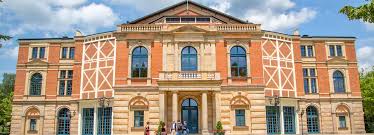
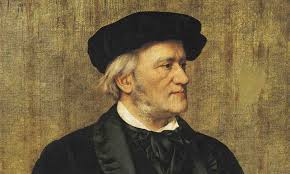
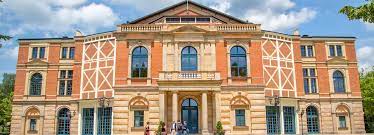
The final stage of my classical CD collection listening-while-driving marathon was (apart from a little Weber and a couple of Zs to complete the journey) my extensive Wagner collection. My very extensive Wagner collection. So extensive that I needed to space it out and intersperse it with some of the classical compilation albums I have as well as revisiting some of the things I had already heard and completing the alphabet before the fat lady sang for the last time. It’s not that he wrote that many different works (11 operas in my collection, plus the one song-cycle and a couple of orchestral pieces) – it’s that I have so many different versions of them and didn’t want to hear them back-to-back. You need to understand that Wagner has been something of an obsession of mine since I first got into “serious” music. The large majority of my visits to opera houses have been for Wagner works.

Anyway, as I said, my Wagner CD collection takes up the most space on my shelves. I have just the one copy each of Rienzi, The Flying Dutchman and Tannhauser, then two Lohengrins, three Tristans, three Meistersingers, four Ring Cycles and four Parsifals. And, if you think that is over-the-top, I also have DVD or blu-ray productions of Rienzi, Tannhauser (2 versions), Lohengrin (3, including the brilliant Werner Herzog Bayreuth production), Tristan (3), Die Meistersinger (4), Parsifal (3) and no fewer than 5 complete Ring Cycles. Thank goodness I can’t watch DVDs in my car!

One of the reasons I revere Wagner so highly is that his achievement is far more than a musical one. Although I obviously loved listening to so much glorious and familiar music again (and again, and again) this time I found myself concentrating particularly on the words and the drama while listening. Wagner’s reputation as an artist is based on his musical achievements, but his skill as a dramatist should not be underrated. It is so advanced that he would surely have been a film auteur if he had been born a century later. Listening in the car, paradoxically, allowed me to focus on this. When you watch a production in the opera house or on DVD, you take the drama for granted and are caught up in it, especially if it is being interpreted by an outstanding stage director and the best singer/actors (and I prefer singers who throw themselves into the roles to those with outstanding voices who just stand there singing). This applies particularly to The Ring, but I will leave that until a later blog and concentrate here on the other works.

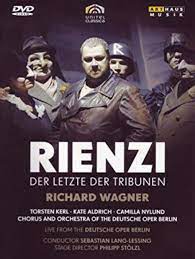
Rienzi is a bit of a strange one. It the last of Wagner’s earliest three operas, but the first that is in any way worth listening to. On the other hand, it does not belong in the same rank as the next three, which themselves are harbingers of his later, mature masterpieces. He took a comparatively long time to find his true level, but the journey there was pretty splendid in itself.  Complete recordings of Rienzi have been rare and the version I have, conducted by Hollreiser on EMI, was among the first to become available. Productions are also rare and the only one I saw in a theatre was the ENO staging in 1983. It actually lends itself well to modern interpretation, though few directors can resist visual references to Italian fascism. That was certainly true of the ENO production, which used film and architectural grandeur to great effect. Indeed, the fascistic statue which dominated the stage in Act 4 remains the only instance when I have heard a set design get a round of applause as the curtain rose. The production from the Deutsche Oper, which I have on blu-ray is very similar and also uses fascistic-style propaganda film. The music of Rienzi has some splendid moments, especially the choruses, but also some longueurs – the drama often drags somewhat and does require startling visuals to be of interest.
After which, of course, he really got going. The next three works are usually grouped together, mainly because they are operas, with arias, duets and choruses, rather than music-dramas, as he preferred to describe his major works. Interestingly, Wagner actually revisited some of the themes and concerns of these three works in his three later non-Ring music dramas, and even in the same order. Thus, the idea of redemption through love-in-death which features in The Flying Dutchman is later given considerably more intensity in Tristan and Isolde, which similarly features maritime scenes. In Tannhauser, Wagner explored the position of the artist (and specifically the musical artist) in society and enlarged on his theories of the artistic process and the conflict between innovation and tradition in The Mastersingers of Nuremberg, both operas also featuring song contests. Finally, the use of the grail legends as source material for Lohengrin was repeated with Parsifal, which is basically a prequel for the earlier work (and what a shame it didn’t become a tetralogy like The Ring – there’s certainly enough backstory in the expository parts of Parsifal).

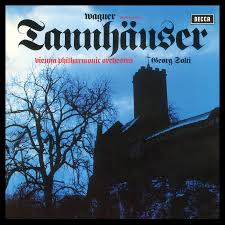
My CD copy of The Flying Dutchman is the classic Klemperer recording on EMI. The best production I ever saw on stage was the 1978 production by Harry Kupfer at Bayreuth, in which the entire story was presented as a figment of Senta’s febrile imagination. This made perfect sense both dramatically and because she has the most intense music in the opera. Similarly, the CD version I have of Tannhauser is Solti’s definitive version on Decca, with Rene Kollo outstanding in the title role, while my favourite stage production is also a revolutionary Bayreuth production by Gotz Friedrich. This caused quite a stir when it premiered in 1972, mainly because of the “workers’ chorus” which brought it to a conclusion. I saw it the following year, on my first visit to Bayreuth, by which time it had been toned down a little, and found it extremely powerful. Fortunately I also have both these landmark productions on DVD.

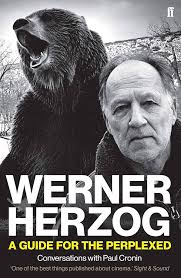
The Claudio Abbado version of Lohengrin, with Placido Domingo in the title role, is pretty good, but I prefer the older DG set by Rafael Kubelik, with James King. My favourite production on DVD has to be Werner Herzog’s Bayreuth  staging, with its beautiful tableaux reminiscent of paintings by Caspar David Friedrich. Herzog also later made a documentary film about the Bayreuth Festival, The Transformation of the World into Music, which was intended for showing on German TV as an introduction to screenings of Bayreuth productions, and is well worth a watch.

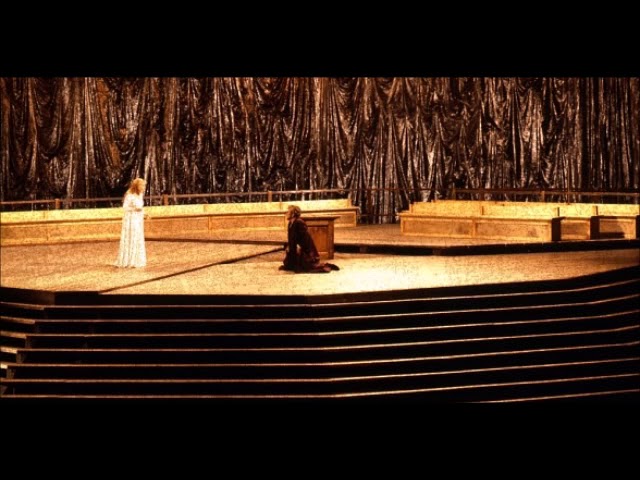
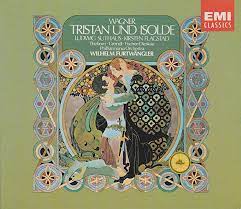
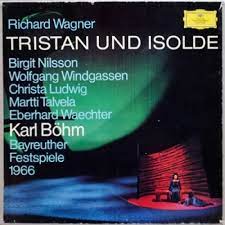
By the time he got to Tristan und Isolde (over half way through the composition of The Ring) Wagner had long since moved from composing operas to creating “music dramas”. The greatest performances of his mature works are those which find the best balance between the music and the drama. However, my two favourite recordings/performances of Tristan are at either end of the spectrum. The 1952 Furtwangler recording (on EMI, in mono) is Tristan as music; the live 1966 Bayreuth recording (on DG) by Karl Bohm is Tristan as drama. You may think that listening while driving would favour the former approach., but, as I indicated earlier, that is not the case; and it is especially not the case with Tristan, where the action is fairly static and the drama comes from the intensity of the protagonists’ emotions.

The Furtwangler performance is intensely slow and beautiful, especially in the love duet in the second act (Hans-Jurgen Syberberg used the recording to tremendous effect in his film about Ludwig II) and, of course, it has the legendary Kirsten Flagstad giving probably her greatest performance as Isolde. The age of the recording (it is older than me!) does not count against it at all. The complete timing of this expansive recording is 256 minutes. Bohm’s urgent performance comes in at 37 mins shorter and fits neatly on 3 CDs (one per act).  It is the best and most dramatic performance because it is live and because it features the two greatest Wagner “performers” (as opposed to singers), Wolfgang Windgassen and Birgit Nilsson, in the title roles. I’d go further – it is one of my favourite recordings of anything. Windgassen is simply astonishing in Act 3 – his intense commitment to the role is complete and sometimes he even seems to spit out his lines. Which of the two recordings ultimately moves me the most? With this work it is impossible to say, because both approaches are valid – that’s the beauty of it.

A good singer/actor in the role of Hans Sachs is vital to the success of any production or recording of the Mastersingers of Nuremberg. On stage, my favourite interpreter was always the wonderful Norman Bailey, whom I saw sing the role many times. He also features on two of the three CD sets of the work which I have: with Goodall in the live ENO production (on Chandos, in English) and in Solti’s studio production (on Decca, in German). And yet, my favourite set is Karajan’s on EMI. Theo Adam may not quite match Bailey, but is, nevertheless a splendid Sachs, while the rest of the cast is superb – especially Geraint Evans as Beckmesser and Peter Schreier as David, both of whom add to the comic aspects of the piece.

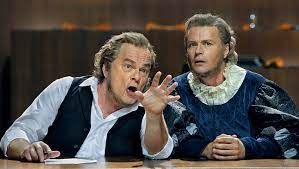
Other Wagner works vie for the title of my favourite, but, when I am actually listening to it, especially the phenomenal third Act, I always find myself thinking: “did he really write anything better?”. And, for me, the crux of that heavenly act is the composition of the prize song, in which conversational dialogue is accompanied by a constant flow of sublime music. And, in that scene, Wagner put into Sachs’s mouth his own feelings on innovation and tradition in art, illustrated by the development of Stolzing’s song. Of course, Wagner was himself a great musical innovator, especially in Tristan, which was the work which preceded the Mastersingers. But he did not espouse experiment for its own sake – it needed to grow organically from existing forms and the “rules” were there to provide a context within which they could be successfully broken. This scene rarely fails to get me, whatever the context of the production, and was a highlight of the Barrie Kosky staging (which I reviewed in my blog of August 26th 2018), in which both the characters were dressed to represent Wagner at different stages of his career. After I had finished my classical collection, my listening-while-driving moved on to some of my favourite rock and pop artists and I found Wagner’s ideas about innovation in music very apposite in assessing what I was hearing. I will return to that in the future.

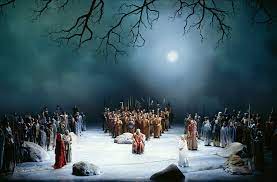
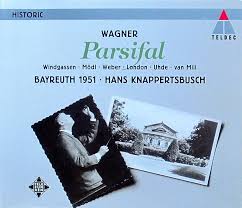
My collection of recordings of Wagner’s final work, Parsifal, like that of Tristan, encompasses the slow and the fast, the old and the less old and the live and the studio. “Live”, in the context of Parsifal recordings, usually means Bayreuth and, as the work was specifically created by Wagner for the unique acoustic and orchestral layout of the Bayreuth Festspielhaus, these recordings must be regarded as the most authentic. Probably my favourite is the 1951 recording by Knappertbusch (which can now be picked up on the bargain Naxos label), with a fresh young Windgassen in the title role and Martha Modl superb as Kundry. Like Furtwangler’s Tristan, it is slow (total run time 272 minutes) and intensely beautiful. By contrast, the live Bayreuth recording from Pierre Boulez on DG comes in at a brisk 219 minutes (close to an hour faster for exactly the same music!). It also includes a wonderful Kundry in Gwyneth Jones, who embodies the difference between the singer/actor and the singer with her blood-curdling screams and groans, which are acted rather than sung.

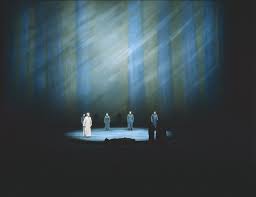
My favourite experience of a staged production of Parsifal has to be my first visit to Bayreuth in 1973, when I was fortunate to get a ticket for one of the performances in the final year of Weiland Wagner’s spare staging which revolutionised Wagner production when the festival re-opened for the first time after the war, and which was the production from which the Knappertsbusch recording mentioned above was taken. Parsifal lends itself well to spare stagings rather than complex ones, as one can concentrate on the music rather than the action (of which there is not a great deal). Having said that, though, I am particularly fond of Nicholas Lenhoff’s production, which I have on DVD and saw a version of at English National Opera.

Anyway, as I said above, I will leave The Ring for a future blog, but it will be back to TV next time out. My driving marathons continue to this day and, after finishing my classical collection, I moved on to some classic rock and pop and will be blogging a few lists on that experience, as well as the classical music lists I promised. 

Going Back a Bit

In my last blog, I added two new titles to my 2023 shortlist, but have missed out naming four more, transmitted between February and June. Basically, this blog has been in preparation all that time, but a fatal combination of being both overly busy and somewhat lazy delayed it beyond the point at which I wanted to publish my thoughts on the most recent stuff. Anyway, it is now time to go back a bit and tie up my viewing for the year so far at the half-way stage.
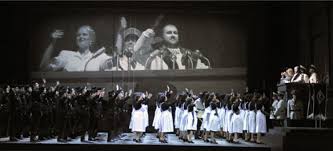
I’m not sure I have named a reality show amongst my best of the year before, but Channel 4 came up with a superb new format, which produced a remarkable finale that was both very moving and extremely enjoyable. The Piano showcased outstanding amateur performances on pianos set up in some of Britain’s main railway stations, which were being secretly watched by internationally famous judges Lang-Lang and Mika. The astonishing Lucy, a blind and learning-disabled 13-year-old girl who found a way to express herself by playing the piano, was always going to win the Festival Hall concert final, but all the other finalists had moving stories too and deserved the opportunity to display their talent. It was one of the most life-affirming series of recent years. 
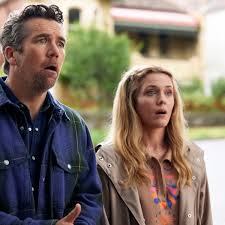
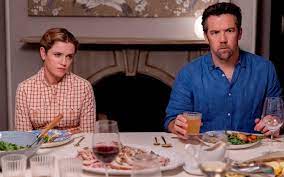
Colin From Accounts (BBC2) is an Australian comedy which lives up to the best of what you might expect from that country’s particular sense of humour and then goes some distance further. It is written and performed by the married couple Harriet Dyer and Patrick Brammall (although they take individual writing credits for alternate episodes) and reminded me a lot of Sharon Horgan and Rob Delaney’s Catastrophe, not least because of the striking physical and character similarities of the leads: he tall, unshaven and sardonic; she blonde, sassy and forthright. It also has its share of some wonderfully embarrassing scenes, especially an awkward and hilarious birthday dinner party in episode six. 

Three years ago, the documentary series Once Upon a Time in Iraq featured in my year’s top ten and the team behind it were back with Once Upon a Time in Northern Ireland (BBC2), which was even better. Dealing with the Troubles from the late sixties to the mid-nineties, it benefitted from greater hindsight, although the participants were only now able to speak about their experiences and some of them did so very cautiously. The interviews were conducted using archive news reports to initiate memories and the results were riveting, moving, sometimes revelatory and presented in a non-judgemental fashion. Everybody here was the victim of an impossible and intractable situation, to which we can only hope there is never a return. The subtitle of the final episode is Who Wants to Live Like That?, a quote from one of the interviews, but the fear of a reversion to the unthinkable horrors of the past was not fully dissipated, which adds to the value of the series.

Having spent much of last year supporting my wife through extensive treatments for lung cancer (chemotherapy and radiotherapy) which were ultimately successful (fingers firmly crossed) we approached the Norwegian series Afterglow (BBC4) as yet another drama series likely to reflect our own lives back at us. To an extent it did, especially at first, but the cancer diagnosis received by the lead character, Ester, turned out to be the starting point for what is really a comedy drama about a circle of friends and their relationships which reminded me of Cold Feet (ITV, 1997-2020) at its best. I would expect it to continue in this vein for a number of further series, until it similarly runs out of steam, but the characters and the cast are extremely strong and it is very watchable, so why not?

So, I have managed to add a reality show, a comedy, a documentary and a drama series to the shortlist, which makes a total of ten halfway through the year. Looks like I will have choices to make this time round.

Not making the cut, though very enjoyable, were the third and final season of Star Trek: Picard (Amazon), which was a spectacular and satisfying conclusion to the best iteration of the franchise since the original series, and Shane Meadows’ The Gallows Pole (Channel 4), a striking series set in the 18th century which was surprisingly funny and very much recognisable as a Meadows project, if ultimately a little aimless. Definitely not for inclusion were the latest series of Inside No.9 (BBC2) which I now watch out of loyalty, but which these days only rarely shows flashes of how brilliant it once was, and Ten Pound Poms (BBC1), which eschewed a number of potentially interesting dramatic possibilities in favour of soapy melodrama and (presumably) the hope of further series. Same old Aussies…….

Now that I’m up-to-date on current TV, I’ll return to music in my next blog.

All at Once

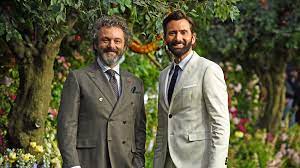
Is there any more complexly self-referential TV show than Staged? Back for its third, and last series, Michael Sheen and David Tennant’s lockdown vehicle spent much of its time debating whether or not there should be (or have been) a third series and incorporating a “making of” documentary into the plot. Already pretty meta, this was its most meta incarnation yet, but its scheduling made it seem even more so. Previously released on Britbox late last year, it received its BBC TV premier last month at the same time as both its stars could be seen in separate outstanding dramatic projects playing the fathers of disabled daughters, and being one of those myself, this was all a bit too much at the same time. Enjoyable though it was, Staged will not be troubling my growing shortlist of the year’s best, but those other two pieces most certainly will. 

Best Interests (BBC1), another phenomenal 4-parter by the king of the format, Jack Thorne, is simply the best thing of the year so far. Michael Sheen and Sharon Horgan were both brilliant and moving as the parents of a girl with a rare form of muscular dystrophy who face the agony of the decisions to be taken when she falls into a comatose state. All the issues about the decision to withdraw life-support are covered from the ethical, medical, legal and sociological standpoints, but ultimately it was about the family involved (mother, father and sister most prominently) and their different ways of coping with the situation. Indeed, I felt that the real subject was their different ways of passing through the inevitable departure of a dearly loved one and ultimately letting go. Marnie’s life expectancy was always going to be limited (indeed, it is mentioned at one point that she had exceeded expectations) but they all needed to go through an inevitable ritual. For Horgan’s character, this took the form of the legal fight for treatment to continue, but it was the personal reactions which resonated most and brought out the best in the actors. The scene in which Marnie’s life-support systems were turned off was wrenching in the extreme but was followed by a serene coda which hinted at reconciliation – both with the sense of loss and with each other. 

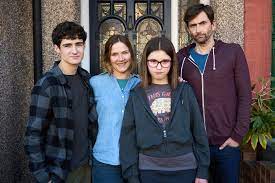
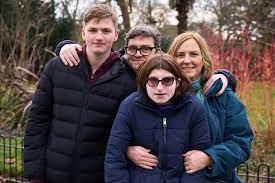
There She Goes (BBC2) followed the evening after the conclusion of Best Interests.Following two outstanding series (covered in my blogs of November 2018 and October 2020), this was an hour-long special which continue the story of learning-disabled Rosie (Miley Locke) and her family (David Tennant, Jessica Hynes and Edan Hayhurst), possibly also bringing it to a conclusion. It remained uncannily like our own lives, though, unlike us, the family finally received a diagnosis of Rosie’s condition, which put them in touch with other families in the same situation. This led to a very neat (and very meta) ending in which they met up with the real-life family whose experiences are the basis of the series – writer Shaun Pye, his wife Sarah Crawford and their daughter Joey. The captions at the end informed us of the background to the special and it has since been trailed, for the first time, as “based on a true story”. So, fiction met reality and seems to have come full circle, but there are still plenty of issues to explore around the experience of parenting and learning disability and I hope this is not the end of it. 

The “real’ family

Scheduling There She Goes directly after Best Interests would seem to be a bit of a mistake in normal circumstances, but having Staged in there as well gave it a little more coherence (on a meta level) in terms of the presence of Sheen and Tennant and maybe that was part of the thinking. 

I referred above to my growing 2023 shortlist but will need to go back a bit in my next blog to expand on that. I have virtually written it already, but I wanted to get my thoughts on the programmes mentioned in this blog down first, so things are a bit out of order. In fact, I actually have two other blogs almost ready, but haven’t yet finished them due to a combination of being both busy and lazy, if that makes sense. Anyway, I’ll be back soon.

January darkness

January is probably my least favourite month. It has all the darkness of December without the delights of Christmas to offset it. The weather usually does its worst and we know we are on the way out of the darkest days, but it seems to take forever to notice it. TV was always the go-to distraction in these dark days, but in recent years broadcasters and streaming services seem to have concentrated on presenting all their best stuff at the end of the previous year (probably for awards purposes), leaving the January cupboard comparatively bare. But not this year. For the first time in years, I have found plenty to engage me and already have four things for the 2023 shortlist!

Sunday nights on BBC1 is usually key at this particular moment and this year, with the third season of Happy Valley scheduled, a strong start was pretty much guaranteed. One of the things I look for in a good drama is ambiguity, but it had been somewhat lacking in the central Catherine Cawood (Sarah Lancashire) character in the first two seasons. She was always so impressively in command, the calm and reliable centre of events, taking everybody’s troubles upon her broad shoulders and coming out on top in the trickiest of circumstances. One thing she seemed to have no trace of was self-doubt and that was a clear flaw. This time round she began to realise that maybe she should have trusted others, especially her sister and grandson, rather than trying to protect them by keeping important information to herself, though it took a falling out with them both and the intervention of the ghost of her dead daughter to bring her to this realisation. Maybe, in the end, her implacable hatred of her nemesis, Tommy Lee Royce (James Norton) was also open to question. Not before the end titles, for sure, but maybe something for her to think about as she walked off into her retirement, like a western hero who had won the final showdown and was heading off into the sunset. A fine ending to a very fine series.

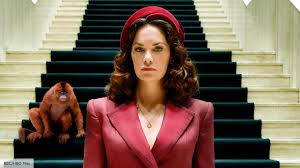
Also on BBC1 on Sundays in January (though it had started in December), and also in its third season, was Jack Thorne’s adaptation of Philip Pulman’s His Dark Materials. Throughout, it had been a brilliant and engaging mixture of fantasy adventure and theological/philosophical themes and it continued in that vein to the end. The scenes in the land of the dead were particularly striking; redolent of Gustave Dore’s monochrome illustrations for Dante’s inferno. And the key character in the season was Ruth Wilson’s Mrs Coulter – like Cawood, somebody seemingly in command, though in her case for selfish and occasionally downright evil ends, but who came to a degree of self-realisation and did the right thing in the end. Another satisfying conclusion.

I don’t usually shortlist third seasons but am glad to make an exception for both these two. His Dark Materials built to a great climax and I had been close to shortlisting it twice before. Indeed, I noted in my blog in December 2020 that, given its provenance as a trilogy of novels, it was probably best to leave it to the end to consider shortlisting it, which has now come to pass. In the case of Happy Valley, I would certainly have included season 1 in my top ten of 2014, but the first two seasons had already been transmitted before I started blogging in 2017, so I am delighted to be able to shortlist the third on behalf of the whole.

Something which regularly adds to the air of gloom in January is the sombre programming which marks the period around Holocaust Memorial Day. It can be unfortunately easy to note its presence without engaging too closely with it, and many of the items have been seen before, but this year it contained two outstanding new pieces, both on BBC4; one of them an extensive look at the subject from a new angle by my favourite American documentarians, the other a piece of inspired documentary minimalism – Ken Burns and Lynn Novick’s The US and the Holocaust and Bianca Stigter’s Three Minutes: A Lengthening. The former was pretty much what you would expect from Burns and Novick, though no less impactful for that, and I don’t think I really need to say any more about it other than that it is automatic for the list. But the latter was a revelation. 

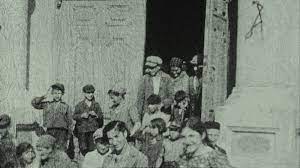
The three minutes in question is a fragment of home movie, some of it in colour, shot in 1938 by a Jewish émigré to America, returning to his home town in Poland. It shows the Jewish community in that town, eagerly crowding around the camera and going about their daily lives. The full three minutes is shown, silently, at the start of the documentary, and for its remaining 66 minutes, you see nothing but images from those brief shots: enlarged, reversed, slowed down, every section of the frame examined for the minutest clues as to what and whom we are seeing and what the film can tell us. It is constructed like a piece of minimalist music, with constant repetition of the same material in different forms, and the more it is repeated, the more mesmerising it becomes.

It also draws you into the world of those people whose community will be destroyed in the coming years. The forensic nature of the enquiry does not lessen the emotional impact of the piece, given even greater strength by Helena Bonham-Carter’s restrained and questioning narration. For me as a career film archivist, it also spoke to many of my professional interests. The searching for clues in the background of the frames and the imperative to put names to the unidentified faces took me back to my cataloguing days. The presentation of the footage in its correct ratio and speed was also important. Digitisation was clearly vital to the manipulation of the images later in the piece, but there was no attempt to “improve” the quality of the images with the sort of software which can add frames, smooth motion and (worst of all) add colour where there is none, until near the end when a brief section was subjected to digital cleaning and Bonham-Carter asks the viewer if the process gives them any greater empathy with the people in the shot; a key claim of those, like Peter Jackson, who are fond of such manipulation. No answer is given in this film. Maybe some viewers would have said “yes”, but for me the moment begged the answer “no”, though maybe that was my own bias showing through (and I like ambiguity in documentary as well as drama, so it was well judged).

Above all, the documentary illustrates precisely how important film is as a historical record, when properly presented. I can’t think of anything, even in the complete works of Ken Burns, which makes that point more successfully and it is very gratifying to people like me who have devoted their time to ensuring its preservation. The section when all the faces are collated into one mosaic image becomes a permanent audiovisual memorial to those who probably have no gravestone.

So, four shortlisted programmes in the first month (and a bit) is a great start to the year. Maybe I’ll be making some choices at the end of it this time.

Season’s Ratings

Despite the sparsity of my blogging this year, I could not let it end without offering my usual top ten TV titles of the year. I certainly did not manage to watch anywhere near everything I would have liked to, so the list comes with that caveat, but I did manage over the last few weeks both to catch up with some of the things I had not yet managed to view in full and to pay attention to some of the more interesting offerings over the Christmas period – the things which already-published lists from the usual suspects tend to miss, but I have often found that something creeps in under the wire in the year’s dying days. Christmas “specials” are often disregarded but have occasionally thrown up something exceptional (exhibit A – The Office). Let’s see if that happens this year.

I mentioned in a previous blog, that one of the things I had not yet caught up with was Peter Kosminsky’s The Undeclared War (Channel 4). I have now done so and have to say that I found it a little disappointing. The idea was great and, initially, the conceit of presenting imaginative visualisations of the intricacies of computer coding made it very striking. However, the more the plot developed, the more tiresome these interruptions became, holding up a plot which was getting a bit stretched anyway and giving you the space to contemplate that fact. 

Last year’s BBC i-Player offering from Adam Curtis, Can’t Get You Out of my Head was prominent in my best-of-year list. This year he gave us TraumaZone, a 7-part study of Russia between 1985 and 1999, covering the collapse of both communism and democracy. Unusually for a Curtis series, we did not hear his voice, so were left with a collage of fascinating archive material, cleverly juxtaposed and accompanied by captions which, while still in the distinctive Curtis style (“at the same time” even made a few welcome appearances) contained more explanatory information and less of the usual Curtis theorising. Indeed, the lack of his own voice, combined with the fact that he pursued an uncharacteristic chronological narrative, put even greater emphasis than usual on his archival choices and the points he conveys by their juxtaposition; and these were remarkable. Most of the material was shot by BBC News crews and most of what Curtis used was raw footage, without commentary, which could be allowed to run at length for maximum impact. It covered multiple facets of life in Russia (and, indeed, Ukraine), giving a fascinating in-depth look at the political, economic and social history of those times. In a year in which Russia has been a dominant feature of the international news agenda, the series also provided invaluable context for greater understanding of what is happening now. I make no apology for, yet again, including a Curtis series in my shortlist, though Can’t Yet You Out of My Head still remains, for me, the best thing he’s done since Pandora’s Box. TraumaZone is the next best.

So, onto those Christmas specials and there were four which particularly interested me this year. Mortimer and Whitehouse Gone Fishing (BBC2) followed the lead of many previous specials and took our heroes abroad for the first time. It was lovely and a very pleasant hour’s diversion, without being a great deal more, given that the three series so far have pretty fully explored the duo’s friendship. Detectorists (BBC2), another tale of male friendship, was exactly the same: it covered ground (no joke intended) familiar from the earlier series and ended in much the same way, with a lost opportunity but no regret. Still very enjoyable, though. I won’t say that the Inside No9 special The Bones of St Nicholas (BBC2) was disappointing because I have already noted in a blog earlier this year that the show has (unsurprisingly) run out of steam. Again, still watchable, but now a long way from the glories of its prime.

None of the above crack my top ten but the fourth of the specials I watched certainly does. Motherland has so firmly established its gallery of characters that it seems all it has to do is let them loose and that it did to wonderful effect in Last Christmas (BBC2). There were enough gags, moments of shock and subtle looks and asides to fill a season and here they all were crammed into what we are told will be the show’s final half hour. It trod a dark path with the lightest of steps and was sublime. 

So, that makes 10. Once again, my shortlist is my top ten list: completed just in time and no narrowing down to do. For the first time, scripted drama and comedy fill only half of the ten slots. My top ten is: 

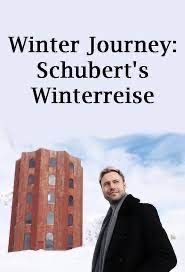
Winter Journey (BBC4)

John Bridcut’s imaginative setting of Schubert’s greatest song-cycle in a winter landscape. A favourite director interpreting a favourite composer, it was always going to make my list.

Sherwood (BBC1)

A state-of-the-nation thriller to compare with the greatest, with a 40-year timespan and instant classic status. A great script served well by an outstanding cast. No second season, please – this was perfect.

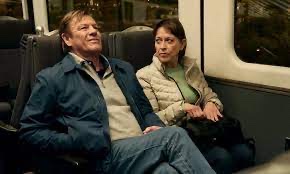
Marriage (BBC1)

Stefan Golaszewski in minimalist mode. Initially perplexing, it stayed in the mind for weeks, thanks to the subtle direction and intense performances. Another season, please – this has much more to say yet.

How To with John Wilson (HBO/BBC2)

Documentary? Comedy? Social commentary? Philosophy? A bit of each and much more than the sum of these parts. And all done on the lowest of low budgets. A real cult classic.

The Sandman (Netflix)

Every time you felt this wildly imaginative fantasy was going really well, it changed direction and got even better. It was also unafraid to tackle complex psychological and philosophical issues. Innovative casting choices, too.

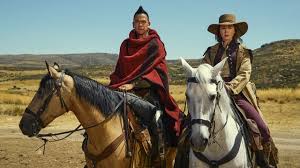
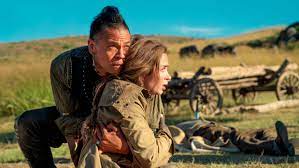
The English (BBC2)

Hugo Blick’s ravishing western, full of his trademark stunning visuals, dramatic set-pieces and reflective dialogue. If I had to choose a “best of the year”, this would be it.

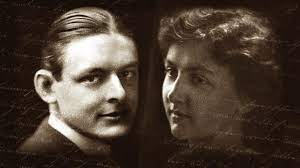
Arena: Into the Waste Land (BBC2)

The BBC’s flagship arts programme at its best, with a thoroughly erudite examination of T.S.Eliot’s The Waste Land on the centenary of its publication.

The Queen’s Funeral (BBC1)

They had plenty of practice for this, but practice makes perfect and it was – just the right tone and a fitting sense of the end-of-an-era moment which it represented. Moving without being downbeat; spectacular without that being a distraction from the point. A true national moment

TraumaZone: Russia 1985-1999 (BBC i-Player)

See above for why I chose this.

Motherland: Last Christmas (BBC2)

….and this.

I have to re-state that this is very much my list, by which I mean that it reflects my own viewing during the year, incomplete as it was, as well as reflecting my tastes and what I regard as significant.  When I look at other lists (The Guardian, BFI, Time Out, Radio Times etc) I find a number of things from streaming platforms to which I don’t subscribe, such as Disney+ and Paramount (Netflix, Amazon and Apple are enough for me), so I can’t comment on something like The Bear, which seems to have made a big impact and is something I am going to have to catch up with somehow. In addition, those lists are the combined efforts of a number of contributors, so they can obviously consider more. Nevertheless, I still find some anomalies between my approach and the other list makers – most notably, I like to give new work preference over returning series. For me, a returning series needs to show a significant improvement over earlier ones to be considered. I noted this in a blog earlier this year and it is basically a Peabody approach, rather than the Emmy habit of re-rewarding previous successes. Of course, a list like The Guardian’s, which has 50 titles, nearly all of them scripted fiction, is bound to contain a number of returning series and the inclusion of some of the excellent titles I mentioned in my earlier blog – Top Boy, Stranger Things, The Outlaws etc. – is no real surprise. What does surprise me, though, is that they could not find space in their 50 for outstanding original work like Marriage or The Sandman.

The last thing to note is the (very) high percentage of BBC titles in my list. I don’t think this is evidence of bias or lack of adventure on my part, but reflects that fact that the Corporation has had a storming year which, given that it has been its centenary, is highly appropriate.

Happy New Year!

The BBC Blog

The BBC has been a massive part of my life. I worked for it for ten years and then closely with it for a further twenty-nine, but it already held a strong place in my affections before I joined it and has continued to do so in my retirement. Its output has dominated my lifetime’s TV viewing, both for professional reasons and through personal choice (65% of my list of favourite British TV dramas are BBC productions and 90% of my list of British sitcoms). Former BBC employees have often been highly critical of the Corporation, not ever through any sort of animosity, but because they know that it is capable of reaching (and setting) the highest standards and are disappointed if it ever falls short. As it celebrates its centenary (which is actually the centenary of the radio service as well as the organisation as a whole, but TV is my main concern here) I was certainly looking forward to seeing how it would mark the occasion, especially through the use of archival materials, but felt that the very best way of doing so would be to produce some great new landmarks to add to the list of 100 which my former BFI colleagues have compiled here

And, happily, that is what it has done. In my last blog I expressed the opinion that Sherwood was the best British drama series for a decade. Well, that accolade only lasted about 6 months! I did not use the term “a decade” lightly but was specifically thinking back to the last series which I would place higher, which is Hugo Blick’s The Shadow Line (BBC, 2011), number 6 in my Top Ten British drama series (see blog, February 2021). And whose work has now taken over the title of “best drama series for a decade”? Why, none other than the same Hugo Blick, back with his best series since, er, The Shadow Line.

It seemed very odd that the BBC should produce a western – not exactly a genre for which it is well known – but it seems perfectly natural that Blick himself should essay the form. You could argue that many of the essential themes and elements of his previous series – the blurred line between good and evil, the nature of trust, the stunning vistas, the dramatic stand-offs and shoot-outs, the search for revenge and uncovering a truth – make them surrogate westerns. And in The English (BBC2 currently and i-Player) they are all there in their natural setting. 

All the other Blick hallmarks are there, too:  a convoluted plot with a number of mysteries at its heart; characters coming to terms with their past and their destiny; the reflective dialogue scenes, interspersed with dramatic set-pieces; a female lead character; memorable supporting characters performed by outstanding actors (with a couple of juicy parts here for Blick stalwarts Stephen Rea and Rafe Spall); an ambiguous narrative which makes you both think and feel at once. It is also a great homage to the western genre, with numerous visual references to the classics, and the ending was perfect in showing how, as Stephen Rea’s sheriff predicts, the myth of the west (which those classics represent) replaced whatever may have been “the truth”. I was particularly delighted with the use of footage from the BFI’s Mitchell and Kenyon collection to make that point. Of course, it goes straight onto my shortlist and will be in my end-of-year top ten (well, I have already said Sherwood will be there, so how could it not be?).

One BBC drama which was certainly produced with the centenary in mind was the Doctor Who special The Power of the Doctor (BBC1), which marked the end of the Chibnall/Whittaker era and featured a number of previous incarnations of the Doctor, as well as his favourite adversaries. It was enjoyable, if a bit of a mish-mash, but was, of course, most memorable for the surprise regeneration of the Doctor as David Tennant. This re-unites him (for a few specials at least) with Russell T.Davies and one can’t help but feel that Davies thought a direct transition from the first female Doctor to the first black one would be too much for the more “traditional” fanbase and is thus keeping their loyalty by bringing back a favourite first. The revelation that we are getting an old doctor back came at just before 9pm on Sunday 23rd October. At almost precisely the same time, the BBC News app notification sounded on my i-phone to inform me that we wouldn’t be getting an old Prime Minister back, Boris Johnson having just pulled out of the contest for Tory leader, which I guess is what you call a win-win situation.

Turning to documentaries about the centenary and going back to my own time at the BBC, when I was the TV Archive Selector in the 1980s, I well remember getting regular visits from the legendary war correspondent Frank Gillard, who had been charged, in his retirement, by the Corporation with conducting confidential interviews with key BBC personnel and others, for use at an unspecified future date, but certainly with the centenary firmly in mind. He would pull up outside the South Block of the BBC Film and Videotape Library in Windmill Road, Brentford and together we would unload cans of 16mm film from the back of his Vauxhall estate and take them to “the cage”, a lockable and highly restricted cell in the safety film vault where the naughty programmes which nobody was allowed to see, like Yesterday’s Men, Dance of the Seven Veils or Brimstone and Treacle, were kept. The interviewees had been told that their contributions would not be allowed to be seen or used  until after their deaths, in order that they should feel free to speak candidly. Several of them had already been used for documentaries about aspects of broadcasting history and I was, of course, keen to see how they would feature in the centenary programmes.

A number of the interviews turned up in John Bridcut’s How the BBC Began (BBC2), a two-part, three-hour survey of the Corporation’s first fifty years, presented thematically rather than chronologically. Bridcut had clearly been working on the documentary for some time and had himself conducted interviews with many of the key people who were still alive (though a lot of them, sadly, no more). As with his music documentaries, his approach to his subjects is empathetic rather than interrogative and he sometimes likes to film them listening to or watching archival recordings. As a result, the documentary was impressionistic rather than comprehensive, but contained plenty of interesting and enjoyable material.

For a more critical approach we would have to go back to David Dimbleby’s three-part Days That Shook the BBC (BBC2, August), though commentators were quick to point out that, being steeped in the culture of the BBC through both his own and his father’s careers, he was not necessarily the impartial observer he claimed to be. Where the Bridcut documentary focussed on the BBC’s first 50 years, Dimbleby’s was almost entirely concerned with the more recent 50, so together they form a diptych and it is little surprise that the former was about pioneering and innovation while the latter considered controversy and conflict. 

Dimbleby, in the best BBC tradition, turned out to be a detached observer of the various issues he considered and was at times a very harsh critic, especially over the BBC’s handling of the Jimmy Savile case, both in terms of how he was allowed to get away with his crimes and how they were (or, more importantly, were not) reported after his death. This was truly a case of the disappointment at the failure to maintain the highest standards which I mentioned above and, coming from a BBC insider, carried more weight than the entirety of the Netflix series Jimmy Savile – a British Horror Story from earlier in the year, which was a good explanation of the phenomenon for an international audience, but not much more.

Among those interviewed by Dimbleby for his series was Emily Maitlis, who, along with the likes of Andrew Marr and Jon Sopel, left the BBC this year to pursue their own journalistic projects which are more akin to newspaper journalism in terms of the scope it gives them for expression of opinion. Nothing wrong with that at all and they are all doing good work, largely thanks to their BBC training. What I would reject though is the criticism of the BBC, whether implicit or, in Maitlis’ case, openly stated, over questions of “balance”, “impartiality” or, the perjorative phrase most commonly used nowadays, “false equivalence”. In a time when there is so much digital manipulation of opinion, we need a strong example of unbiased news coverage more than ever and that is what the BBC is specifically and statutorily there to provide. It may not always get to “the truth” of an issue but it is vital that it exists. This was brought home to me by the cartoon below, which I found on social media. 

It is funny and makes a great point, but, thinking further about it, I came to the conclusion that “the idiots” must be given a say. If not, they will not be short of platforms for their ideas and will be able to say, with justification, that they have been censored by the mainstream media, which will give them further strength. Better to acknowledge their existence and challenge them openly. In a year which has seen so much political turmoil, I think BBC News has provided a true public service.

Still with documentary, the beginning of the BBC was not the only moment of great cultural significance in 1922, which also saw the publication of the “greatest poem of the 20thcentury”, T.S.Eliot’s The Waste Land (a personal favourite, though I actually think Prufrock is even better), so it was highly fitting that this other centenary should be marked under the banner of the BBC’s most influential arts series, Arena. And a terrific piece Into the Waste Land (BBC2) was – given plenty of time for an in-depth consideration of the poem’s complexity, with recently discovered letters throwing new light on its meaning, interviews with erudite academic talking heads and an archival recording of the man himself reading his own words. Another documentary for the shortlist.

But it has not just been the programmes specially prepared for the occasion which have resonated in this BBC centenary year. It has sometimes seemed that events have conspired to emphasise the Corporation’s history and its centrality to our culture and our national life. One such was that warm summer night in late June when Paul McCartney took to the Pyramid Stage at Glastonbury. Just turned 80, he put on a stunning show featuring his music from the past six decades. It was BBC history, but only by nostalgic association – and, of course, it was brought to us by the BBC.

If I had to name just one thing which the BBC does, which I regard as the most essential and the most praiseworthy, I think I would have to say The Proms. The Corporation has run this fantastic music festival, a true national institution, since 1927, broadcasting all the concerts on radio and many on television, and its own orchestras feature prominently. This year saw the return of a full Proms programme after the interruptions of the pandemic years and the crowds flocked back. Tickets for the best concerts were hard to get, but I secured one for John Eliot Gardiner’s performance of Beethoven’s Missa Solemnis on September 7th. It was superb and I was delighted to have been present at the festival in BBC centenary year and made a mental note to watch the Last Night on the coming Saturday. But the next day, something happened which ended the season early and which, more than anything else, provided the historic resonance I mentioned above.

The BBC’s hundred-year history has been closely associated with the monarchy. It was the Queen’s coronation in 1953 (the year I was born), which helped establish the BBC television service as a central part of national life and the symbiosis continued throughout her long reign. Her death on September 8th and the commemorative events of the subsequent weeks, as well as the accession of the new King, saw the BBC at its best. True, they had been preparing for it for a long time, but nevertheless there were important choices to be made about the extent and tone of the coverage and they got it pretty much spot-on. The day of her funeral was impeccably observed, the coverage was superb and the presence of the ageing David Dimbleby, who has been so closely connected with so many royal occasions, as commentator for the final ceremony at Windsor, was perfect. It truly felt like the end-of-an-era moment which it was. Certainly the TV broadcast of the year.

And, of course, the occasion demanded the extensive use of archive material from the entire history of the BBC, given that the Queen had been born in 1926. Together with the documentaries and the repeats of classic dramas which I mentioned in my previous blog, as well as the re-positioning of BBC4 as an archive channel, this meant that the archive has been utilised this year more than ever before. It is also now more accessible and appreciated than it has ever been, as you can judge from this Guardian piece. I have always been proud of the small contribution I made towards the creation of the BBC Archive and pieces like this, as well as the centenary celebrations, have only served to reinforce that feeling. The BBC may be facing an uncertain future, but its past is secure. 

Old Favourites (Parts 1, 2 and 3)

Long time, no blog – and an even longer time without a TV blog; in fact I haven’t produced one in 2022 before now. Apologies for that, but it has been a strange year. In addition to my continuing responsibilities towards my (very) elderly mother and learning-disabled daughter, my dear wife has been diagnosed with lung cancer and has undergone a lengthy course of chemotherapy. I have therefore spent a considerable amount of time driving and caring for three generations of those dearest to me, and, while I have managed to watch a reasonable amount of TV at the same time, getting my thoughts down about what I have seen has been less successful.

Actually, that’s not entirely true. I did start writing in the early summer and called the blog “Old Favourites”, for reasons which will become clear, but, having started, I didn’t finish, time went on without publishing anything and the TV landscape changed somewhat. I will therefore present this blog in three parts – the first of which should have emerged several months back.

Part one: Old Favourites

The only TV I have mentioned from 2022 so far was John Bridcut’s film of Schubert’s Winter Journey (BBC4, February) which fitted neatly into my previous blog about the music I was listening to on my drives. It was as wonderful as I had anticipated, given my love of the music and admiration for Bridcut’s work. Pretty much a shoo-in for my shortlist.

However, although I was finding plenty to watch and enjoy, it struck me around the middle of the year that virtually all of it was returning series of things I already know I like. Is this because that was the only good stuff on offer, or is it an indication that I am beginning to get too old to recognise and appreciate (and yes, to enjoy) innovative work, or maybe to relate to the behaviour patterns of the younger generations being portrayed? I have always been reluctant to shortlist things I have already included in previous years’ top 10s unless they have shown significant improvement on earlier seasons, but how could Star Trek: Picard (Amazon), Stranger Things (Netflix) or Top Boy (Netflix) manage to go one better on what they have already delivered? The answer was that they couldn’t, but they did provide me with my favourite viewing of the year to that point. Picard is, I think, the best Star Trek since the original series and promises much for the third and final season. Many thought that the considerably darker tone of this year’s Stranger Things made it the best so far, but I prefer to see it as a progression, as the characters (and the wonderful cast playing them) grow from kids to young adults. Top Boy continued its magnificent and riveting return and, of the three, is the one I would be most inclined to shortlist, but for the time being I won’t. They will be there, in abeyance, if not enough great new stuff shows up.

Old favourites were also in evidence on terrestrial TV, particularly the BBC. Inside No.9 (BBC2), an all-time favourite of mine, was back for a seventh season. Unfortunately, the amazing level of quality this series has maintained for so many years now seems unsustainable and this was the series where it failed to live up to the reputation which preceded it. Only A Random Act of Kindness was up to previous standards. It was too much to expect it to continue to surprise, which is its very essence, and too many episodes here were self-referential or covered already trodden ground. Mr King, for example, was a re-imagining of The Wicker Man, where the “religion” pitted against the forces of rural paganism was environmentalism. Nevertheless, that episode did contain some of the best laughs of the series.

The Outlaws (BBC1), which made my top 10 last year, returned swiftly for its second season and continued exactly as it left off, which was highly welcome though, again, not shortlist-worthy. Better Things (BBC2), in the meantime, came to a very satisfying conclusion.

Part two: Old favourites in new settings

At about the time I should have been publishing this blog, new things started to arrive, many of which were the work of my favourite programme makers, or which demonstrated older-style merits, or which simply had great casts of favourite actors. I thought that would provide a neat thematic way of ending the blog, so I put it into temporary abeyance, but have not been able to pick it up again until now.

The pivotal series was Sherwood (BBC1) – quite simply the best British drama series for a decade: up there with the likes of Edge of Darkness, Our Friends in the North, Holding On, Happy Valley and even The Shadow Line, all of which it had things in common with. It had the old-style merit of making you desperate to know what happened next but made you wait for the next transmission and was very cleverly scheduled – two episodes (of the six) every Sunday and Monday for three weeks, with tremendous cliffhangers at the end of the second and fourth episodes to increase the sense of anticipation (and with no recourse to i-Player). But it was not just a thriller – it was a social and political meditation on the state of the nation to boot. And the cast! Leslie Manville and David Morrisey leading a seemingly endless gallery of wonderful and reliable character actors who have populated the best British TV drama of the past 40 years, which is the time-span of the series. There is talk of a second series, but I really hope it doesn’t happen. This one ended conclusively and satisfactorily and deserves to stand alone as the masterpiece it is, rather than risk being downgraded by a sequel which would have no hope of replicating its impact. 

I do, however, hope there are further series of Marriage (BBC1). The work of Stefan Golaszewki ranks very high in my canon and I was eagerly anticipating his latest, especially as it features Sean Bean, Nicola Walker and James Bolam. I wasn’t expecting what we got, though, and it was initially perplexing. His previous series, Him & Her and Mum, had been dramatic comedies presented in half-hour episodes with a real-time narrative and a single location. Here we had hour long episodes and a more traditional editing pattern. It was drama rather than comedy and the absence of Golaszewski’s usual wicked sense of humour also confounded expectation. It was slow and minimal but had real depth and stayed with me more than even Sherwood had done. There are so many unspoken background details which were hinted at and which I hope will emerge in future series. Unlike Sherwood, however, it was badly scheduled; its experimental nature made it unsuitable for the Sunday 9pm slot on BBC1, which carries very specific expectations, and the negative response it got from some quarters was, I think, a direct result of this. I hope that does not impact on any decision to commission more. Both Sherwood and Marriage go on to my shortlist and will be in my top 10 without a doubt.

There were two other new works from favourite programme makers I wanted to include in the blog: Peter Kosminsky’s The Undeclared War (Channel 4) and David Simon’s We Own This City (HBO/Sky Atlantic). However, at the time of writing, I have still not managed to complete my viewing of either, so will need to come back to them. And, in the meantime…

Part three: New Favourites

Clio Barnard’s The Essex Serpent (Apple TV) was handsomely mounted and excellently acted and directed, but took some time to get going. Indeed, it was only when it decided that the monster was a McGuffin and the real story was the love triangle that it actually took flight in the final three of its six episodes. Enjoyable, but not enough so to gain “favourite” status.

The Sandman (Netflix), on the other hand, is an instant favourite. It started well, with brilliant effects and an imaginative narrative and then went up a level, not once but four times!  The fourth and fifth episodes brought the story of how the Sandman recovered his powers to a terrific conclusion and featured yet another stunning performance from David Thewlis. There was then the pivotal stand-alone episode 6, much remarked upon in the critical response and featuring two riveting strands, in the first of which the figure of Death, presented as a kindly young woman, wandered around Richmond carrying out her sad duties (shame she didn’t bump into Ted Lasso!), while the second was a cautionary tale on the perils of immortality as well as a clever history lesson – so much in a single 45-minute episode. The second main story of the series was a more densely plotted affair (and darker, including a conference for serial killers!) which was exemplary in its use of fantasy to address big philosophical themes. The section ended with the forces of hell about to launch an invasion of the dream world, but then the final episode went off in a completely different direction, with another two-part presentation: firstly a section presented in animation and echoing the graphic source material, followed by another cautionary tale about a writer’s Faustian pact to achieve fame, which came across like a Tale of Unexpected Mystery and Imagination. I expect the hellish invasion will have to wait for another season, which will be much anticipated. Another remarkably successful aspect of the series was the diversity of its casting, especially as regards gender, with the startling presentation of the character of Death matched by the brilliant performance of Gwendoline Christie as Lucifer.

The Sandman was a lavish production, with terrific sets, costumes and special effects and expensive actors. But you don’t have to have a big budget to make something striking and effective, just a genius for what will work. At the very opposite end of the budgetary spectrum we find How To with John Wilson (HBO/BBC2) which has a deliberately amateurish and “home-made” feel to it and it has become a big new favourite of mine. The two series we got this year were both made and aired in the US in the last two years, but it is new to a British audience so it is fair game for my 2022 top 10. 

Wilson’s show is a hybrid of comedy and documentary, in which his approach to interviews and the “real” events he attends is similar to that of Louis Theroux, but all the surrounding material is a collage of randomly shot material presented in a humorous way to illustrate (or maybe inspire) his hilarious commentary and, very subtly, making serious points at the same time. He will start off investigating a fairly mundane topic, often in the style of a self-help YouTube video, but will then stray into the more profound implications of the subject, which you had probably not considered. A great example is the one called How to Cover Your Furniture, which turned into a meditation about what constitutes genuine experience. The voice over adds to the effect, Wilson’s halting and confused delivery covering the fact that he knows precisely what he is saying and trying to get across. You laugh, learn and think all at once – it’s pure genius!

So, that’s another two definites for my end-of-year list.

My recent viewing has also encompassed some very old favourites. This being the BBC’s centenary year, BBC4 has been showing a number of great archival dramas, inspired by a list of “game-changers” compiled by my former colleagues at the BFI. I was particularly pleased to get the opportunity to see in full for the first time, The Roads to Freedom from 1970. This was classic BBC studio and videotape drama of the highest order, still clearly a ground-breaking milestone all these years later. Another BBC milestone are the 1960s series of Johnny Speight’s Till Death Us Do Part, which still retains the power to shock and astonish. Too hot for the BBC to handle in today’s climate, they cleverly allowed all the surviving episodes to be aired on That’s TV.

The main centenary celebration is yet to come, though, so my next blog will be focussed on the BBC and what it means to me. I will also consider some recent documentaries and the monumental broadcasting event which the death of the Queen and the accession of the new King entailed.