


October 5th1969 was a cool and misty autumn Sunday – I remember it like it was yesterday, rather than 50 years ago. In the late afternoon I went to visit my cousin, who was in a local hospital after an unfortunate accident. We were both fans of TV comedy – Not Only, But Also (BBC, 1965-70) and At Last the 1948 Show (Rediffusion, 1967) were particular favourites – and I told him there was a new programme starting that night on BBC1 which looked interesting. It had some excellent names involved – above all, John Cleese, who, through his radio and TV work had become a firm favourite of us both.
At 10.55pm my father and I sat down to watch it – the next day was the start of the school week, so this was quite late. The show opened on a seashore. A man emerged from the gentle waves and slowly made his way to the beach. He was wearing torn clothes and had a straggling beard – the classic image of a castaway. He falteringly dragged himself towards the camera, collapsed and looked up into the lens – we knew this was comedy and could hear the audience laughter, so we prepared ourselves for the traditional laugh line, which was surely about to be delivered. But all he said was……….”It’s”.
There then followed a sequence of surreal animated images incorporating the opening title, with Cleese’s unmistakable tones calmly announcing that it was, indeed, Monty Python’s Flying Circus. But, back in the studio, things were still not going as anticipated. A presenter (Graham Chapman) took his seat and a pig squealed, at which point one of a 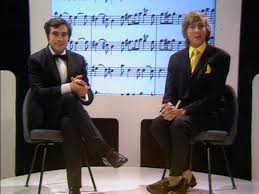 line of drawn pigs on a blackboard was crossed out. This became a running gag throughout the show, both in the sketches and the animations which interrupted them and (sometimes) linked them. A number of parodies of arts programmes made up the bulk of the show and the laughs began to flow (particularly, from me, at the unfortunate Arthur “Two Sheds” Jackson). At the end, we got an extended sketch which seemed to be on more familiar ground – a parody of World War II movies, in which the British were developing a killer joke, that would not have been out of place in the Goon Show.
Finally, the castaway was prodded back into life and made his way back into the sea as the end credits rolled, incongruously giving the title of the episode as “Whither Canada?” (many years later, I won a set of Python scripts in a competition in the Independent newspaper for knowing this subtitle, a well as the line of the Lumberjack Song following “I cut down trees, I skip and jump, I like to press wild flowers” – answer at the foot of this blog). We were not to know at the time, but this was one of what became very rare occasions when the opening titles started the show and the end credits closed it, as Python began its constant parodying and flouting of television conventions.

To be honest, I wasn’t really sure what to make of that first episode. I hadn’t laughed as much as I had expected, but I had most certainly been intrigued by its bold experimentation and I knew I would be back for more. And was I ever back – back for good and for ever! And did I ever start to laugh – often uncontrollably and until it hurt and I couldn’t hear the next line. And, as that first series progressed, so the team began to develop the seamless flow of material, linked by Terry Gilliam’s brilliant animations, which became their trademark. Before long, we were getting episodes which were coherent and integrated works of genius, rather than a collection of outstanding and hilarious sketches.
Python hit me at just the right time – between finishing at school and starting at University. It was ideal fare for the student – intelligent and anarchic – and one of the first things I joined in my freshman year was the Oxford University Monty Python Appreciation Society (OUMPAS). I wasn’t one for going on street demonstrations (very  popular amongst students in the early 70s) but I did take part in the OUMPAS Silly Walk through the streets of Oxford. My walk was not particularly silly and could certainly have done with a government grant to develop it, but then it would have taken a lot of effort to be really silly over the distance involved. I bought all the long-playing records (the only way of re-experiencing the show at the time) and played them over and over, memorizing both the words and the inflections by osmosis. I can still give you all the cheeses from the Cheese Shop sketch, in the correct order.
Later on, my career as a television archivist gave me opportunities to be more than just a fan. I met all the Pythons apart, alas, from Graham. As the BBC TV Archivist, I was able to ensure that series 2 episode 13 was reconstituted as originally transmitted (with the Undertaker Sketch at the end) when the BBC Library only contained the re-edited version. When I was at the BFI, recovering lost episodes of At Last the 1948 Show brought me into contact with John, while I was able to work closely with Terry J on restoring lost material from The Complete and Utter History of Britain (LWT, 1969), recovered on an obsolete videotape format which only we could play. Terry G was a governor of the BFI while I was there, Michael a visitor to our Conservation Centre on one of his less exotic travels and Eric a guest at a National Film Theatre event.
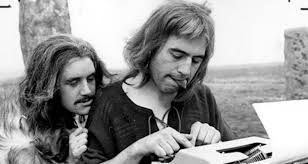
On the 25th anniversary in 1994, I went into a central London studio on a Sunday lunchtime to do a live satellite interview about the significance of the show on (appropriately) Canadian (CBC) breakfast television. They asked me to say that the  Argument Sketch was my favourite, because that’s what they had a clip of. Fortunately, it was, indeed, one of my very favourites, so I was able to eulogise without argument. The interview was just five minutes rather than the full half-hour.
As I said in an earlier blog (Ten TV Programmes that “Made Me”, Aug 6 2018) my entire world outlook has been influenced by Monty Python’s Flying Circus – my general air of flippancy, of not taking anything too seriously, of always immediately looking for the funny side of any situation, the cheerful atheism, the always looking on the bright side; and, just as so much of our language contains phrases and sayings that originate in Shakespeare, so barely a day goes by without my regular discourse containing something that can be traced back to Python, whether in conversation or commenting on Facebook or this blog. For me, personally, it is the most important television show I ever saw.
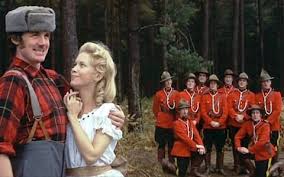
And the answer to the second question in that Independent quiz is: “I put on women’s clothing and hang around in bars”. As if you didn’t already know.
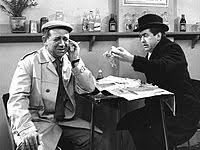
 Clement and La Frenais, Linehan and Matthews, and Barry Cryer. However, there is a glaring omission – even these luminaries have somehow managed to produce a top twenty sitcoms list containing nothing by the generally acknowledged masters of the genre – Galton and Simpson. This is not just an oversight – this is mind-bogglingly wrong.
 Comedy Lecture, Ben Elton made the case for the traditional sitcom, recorded in a television studio in front of a live audience, and argued that it is a classic genre which is nowadays looked down upon by devotees of newer forms of comedy, made on location without a laughter track. Now, I am probably one of those Elton is thinking about – most of my favourite TV of the past two decades (both British and American) has been half-hour shows which are ostensibly comedy, but which have a serious edge (sometimes a very serious edge). Some of them are made primarily for laughs, but some are not – some are closer to drama than comedy (and never mind the duration). Another thing that sets them apart is narrative development across episodes, whereas a traditional sitcom usually has self-contained episodes which could be shown in any order. There could certainly be a separate list of half-hour comedy-dramas, but it would contain mostly recent material. Perhaps that is one for the future, or perhaps some of the titles may belong on drama lists, but for the present I am going to include both traditional studio and modern single-camera sitcoms on my list, as did the Radio Times, because I can’t think of any better way to do it.



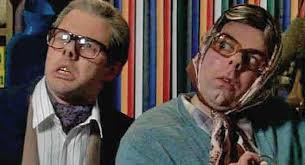

 The Four Yorkshiremen sketch first appeared as the last item of the 6th edition of the second series of At Last the 1948 Show, written and performed by John Cleese, Graham Chapman, Tim Brooke-Taylor and Marty Feldman. The show featured sketches by members of the quartet, linked by a hostess – “the lovely” Aimi MacDonald. The final sketch of each show usually featured all four writer/performers. Which of them actually wrote the Four Yorkshiremen sketch was long a matter of dispute, though it seems that Tim came up with the original concept and he was given a credit of thanks for it on the recent Monty Python re-union shows.
 The thing that has made this sketch seem such a classic is the fact that it has been re-performed many times, with different casts, usually as part of live theatre shows, particularly charity galas. it’s first stage outings were as part of Monty Python Live shows, first at Drury Lane (recorded in audio only), then at the Hollywood Bowl, which was filmed. Strangely, Cleese was not involved in that performance – Eric Idle taking his part. Chapman played the same role as he did in the original, with Michael Palin filling in for Brooke-Taylor and Terry Jones for Feldman. And so began the association with Monty Python’s Flying Circus which persists to this day, and it is regularly referred to as a Python sketch. Other performances followed in such events as The Secret Policeman’s Ball and Comic Relief, as well as the most recent Python re-union shows at the O2 referred to earlier, though none have come close to rivalling the perfection of the original, probably because the need to declaim in a theatre ruins the essential rhythm of the piece. Guest performers have included Rowan Atkinson and a revival for Amnesty in
 2001 featuring Eddie Izzard, Harry Enfield, Vic Reeves and Alan Rickman was more of a parody than a performance. More recently, the Four Fundraisers sketch for Comic Relief starred Izzard, John Bishop, David Walliams and Davina McCall trying to outdo each other with their tales of the remarkable things they had done for charity (of course, the sketch is introduced with the Monty Python theme!). You can see them all on YouTube, together with countless amateur versions and even one in Hungarian! (hopefully not a misleading translation).
 of the International Federation of Television Archives I approached Sten and Lasse from SVT and asked them if they had any knowledge of this. “Oh, yes”, they replied, “we have them. We bring them out every Christmas for a laugh”. They promised to send me copies and confirmed that they had five shows, but when they arrived they turned out to be compilations of sketches from both series, edited together for international distribution, rather than original programmes. The Four Yorkshiremen sketch, however, was there and we showed it at the National Film Theatre. Shortly after that, Dick, Veronica Taylor and myself founded
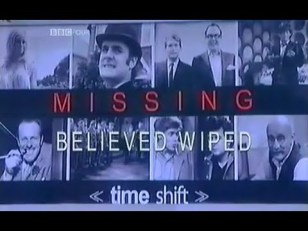 the BFI’s Missing, Believed Wiped campaign to search for lost British TV shows and At Last the 1948 Show has been one of the great successes. Copies of the shows have come back from private collectors, from overseas (ABC Australia) and from the archive of David Frost (who was Executive Producer). There are now only three of the 13 shows which are incomplete, and the search goes on for those.
 And the existence of the telerecordings allows a long-overdue re-evaluation of the show itself, which until now has been seen mainly as just a pre-cursor to Monty Python’s Flying Circus, but deserves recognition as a true classic in its own right. Python was more formally innovative and had the greater impact, but the 1948 Show is more consistently funny across its 13 editions. John Cleese, Tim Brooke-Taylor and Aimi MacDonald have all enthusiastically joined in the screenings of the recovered shows and Cleese notes in his autobiography, So, Anyway (Random House, 2014) that he was delighted and surprised at just how good the material was when he got to see it again. The 1948 Show also beat Python to the use of a well-known phrase now indelibly associated with the latter: the words “and now for something completely different” were first spoken by Aimi MacDonald in one of her links between the sketches.
 TV for Keeps