

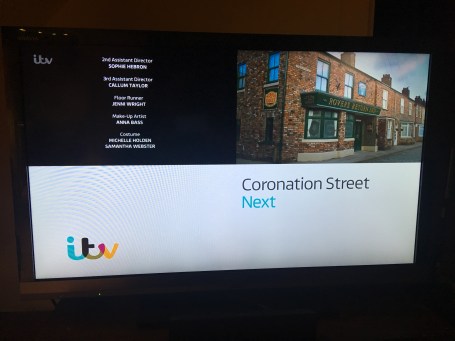
Returning to Netflix recently after not having viewed there for a while, I was delighted to discover that they have changed their policy on the presentation of end credits. Whereas, previously, the end credit sequence would be squeezed into a box so small as to render it illegible, while the rest of the screen was devoted to encouraging you to watch the next episode or something else, the default position is now to move you directly to the next episode unless you select the “watch credits” option, in which case they are presented full-screen. This is what I would expect and hope for from a subscription service and the previous policy had come as a great disappointment.
Does this really matter? Well, to me it does, yes, and not just because I have always had an interest, both professional and general, in reading the names of those involved in the production I have just seen. Just as a good opening titles sequence sets the mood for what is to follow (and I never fast-forward through it, no matter how many times I may have seen it), so a thoughtfully composed end credits sequence gives us time to reflect on what we have just seen, as well as maybe commenting on it with a well-chosen piece of music (a comparatively recent development, this, though one which can be traced back to Our Friends in the North and beyond).
At the BFI, we collected a lot of programmes for the archive by recording them as they were transmitted, including all the “ephemeral” material around them, so I was particularly concerned about the exact nature of what we had acquired. Looking back at some of these recordings for a conference we held to mark the 25th anniversary of Channel 4 in 2007, I was struck by the funereal pace of many of the end credit sequences in the 1980s. But it was Channel 4 which first essayed the interruption of end credits for promotional purposes in this country, when it used the closing of the arts strand Without Walls to promote the following week’s programme. With the deregulation of commercial television in the early 1990s, came the introduction and rapid adoption of the voice-over promotion during end credits, designed to tell you what is coming up and dissuade you from changing channels, and it was enthusiastically copied by the BBC, who didn’t mind too much if you changed channel, as long as it was to another BBC one.
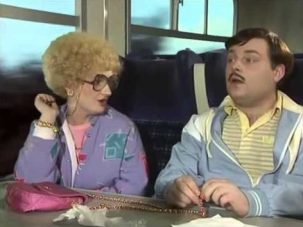 And it was mostly on the BBC that some shows (it seemed to me) started to fight back against this cultural vandalism. The Fast Show interrupted its end credit sequence with its trademark brief sketches, Tony Garnett’s The Cops used police radio chatter instead of a closing theme tune (difficult to talk over) and the medium-savvy Charlie Brooker directly challenged the BBC to interrupt his closing sequence on one of his “Wipe” shows (which they did, in good humour of course). Over on Channel 4, Chris Morris left the end credits off Jam entirely, replacing them with a web address where he had posted them (jamcredits.com – though you won’t find them there any more, just a commercial for how to build your own website).
By and large, though, programme endings were ruined without discrimination. One that I remember particularly was Ricky Gervais and Stephen Merchant’s Extras. Each programme ended with a moment of humiliation for Gervais’ character, Andy Millman, followed by a reflective pause, then the slow introduction to Cat Stevens’ Tea for the Tillerman – a beautiful ending, always ruined by the continuity announcer’s voice-over. Except on one occasion in the second series: the episode featuring a guest appearance by Chris Martin of Coldplay, playing, as was the convention of the show, an exaggerated version of himself as an egotistical control-freak. Instead of Cat Stevens’ recording of “Tillerman” closing the show, we got the same song performed by Martin. So, the joke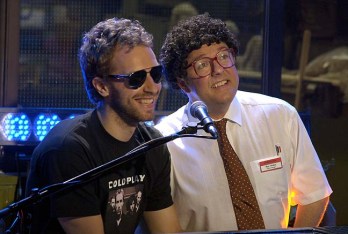 was that Chris Martin was such an egotist he even insisted on singing the closing song himself. But the joke went even further, because there was no voice over to spoil it. Was the joke that Martin even insisted on singing uninterrupted by continuity? And did Gervais need to negotiate this with the BBC for it to work? Whatever, it only works in the context of every other end credit sequence in the series being interrupted – in other words the joke only works “live”, which makes it really ephemeral!
The “fightback” was short-lived, though. The BBC’s guidelines for the supply of programmes by independent producers soon made it clear that material of editorial significance or any speech should not be included in end credit sequences, a lamentable restriction on creative freedom by a public service broadcaster, and the current guidelines also take account of the most pernicious of the promotional developments: the squeezing of end credit sequences into small boxes in the corner of the screen. Many productions now use credits in larger lettering and still frames (rather than rolling credits) in an attempt to make them seen.
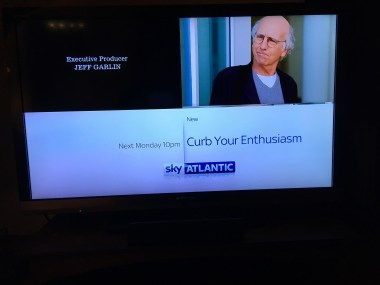
Now, I know that, in terms of credit information, it is all available if I care to look. Embedded metadata on many streaming services, such as Amazon, means that you only need to pause the frame to find out who the actors are or what piece of music is playing and there is plenty of information available on-line. There have been a few recent signs of improvement on broadcast TV, too. The BBC’s channels now allow the credits to  occupy more half the screen, while Channel 4 splits it in half and has clearly asked its suppliers to provide programmes with credits which only run on the left side of the frame, so they are designed for this form of presentation rather than lost in the squeeze. ITV and Sky still regularly squeeze the credits into a quarter of the screen, though, and, of course, they all continue to use voice over.
There are also some other ways around the problem for obsessives like me: watching BBC programmes on i-player rather than on transmission is one (in Channel 4’s case it’s best to record, as the compulsory ad breaks on All4 are interminable); and, of course, for the programmes you want to keep, getting them on DVD or Blu-ray, which will give you the “definitive” version. I still cherish the complete experience of watching a programme from the beginning to very end. It was the same when I was a regular cinema-goer. I would never leave until the final credit had rolled, even when they turned on the lights and cleaners asked me to leave because the film “was over”. Oh no, it wasn’t!
Anyway, I can’t bring myself to be too grumpy just now, because CURB IS BACK! – a cause for true rejoicing, even if the end credits are spoiled.
If you have been affected by the issues raised in this blog, get over it!
 This is certainly the case with David Bianculli’s The Platinum Age of Television (Doubleday, 2016), which seeks to place the recent upsurge in quality material in the context of the evolutionary development of programming throughout the medium’s history and, as such, becomes pretty much a history of TV programmes in selected genres. In 1992, Bianculli published a wonderful and (for me) highly welcome book called Teleliteracy (Simon and Schuster), which was an argument for taking TV seriously as art but was, essentially, defensive, whereas the new book is flat-out celebratory (often referencing the same programmes). Bianculli identifies his Platinum Age as beginning in 1999, the year of The Sopranos and The West Wing, but sees it as a culmination of a progressive process and identifies what he sees as the key milestones from the previous 50 years. Each milestone programme is the subject of a short essay and the book also features profiles of, and interviews, with key creative personnel (including Matt Groening, David Chase, Vince Gilligan, Amy Schumer, David Simon, Louis C.K. and more), whose responses about what influenced them validate the choice of milestones and create a canon of 90 titles over 18 genres. The number of genres and sub-genres is impressive, especially in comedy (including a list of 5 key “single working women sitcoms”) but factual television is largely ignored – the only factual title to make the canon, Ken Burns’ Civil War, is awkwardly included under “miniseries”! A few British titles also get in, but only in the context of US transmission (understandably).
 Published at almost the same time in late 2016, Alan Sepinwall and Matt Zoller Seitz’s TV (the Book) (Grand Central) covers much of the same ground. It is subtitled “Two Experts Pick the Greatest American Shows of All Time”, which has the merit of making it clear that the rest of the world is excluded – I get a bit pissed off when just a handful of British and other non-US titles are included in American-dominated lists, as though that is all that is merited (don’t get me started on the Writers Guild of America list of the hundred “best written TV shows”!). Much else is excluded as well and the authors do a good job of explaining their meticulous methodology, and the reasoning behind it, upfront. In fact, the list of 100 “greatest” is confined only to drama and narrative comedy (i.e. sitcom). Not only that – miniseries are excluded also, though “one-season wonders” (which may have hoped to be renewed, but were not) are given special dispensation in the point-scoring process to be included. As a result, series of the significance of Roots or the quality of Band of Brothers don’t make the canon, while titles of considerably lesser quality and impact abound in the lower reaches, which seems rather perverse. The authors do list 20 miniseries in a separate chapter, and an impressive list it is too, which only emphasises the anomaly.
 These books weigh in at almost 600 and just over 400 pages respectively. My third book is a mere 200 pages (and they are pretty small pages at that!), but contains plenty of engaging argument and memorable wit, because it is by the great Clive James. Now housebound because of severe illness, James has returned to the sort of TV criticism we enjoyed in his weekly Observer columns in the seventies. I remember staggering home under the weight of both the Observer and Sunday Times and their endless supplements, just so that I could read the TV columns by both James and Dennis Potter. James’ Play All: A Bingewatcher’s Notebook (Yale University Press, 2016) sees him catching up with the last two decades of TV output via box sets and streaming services, so again, many of the expected titles are covered, though this time with James’ inimitable comparative references to classical literature, movies, philosophy and so on – only he would cite Nietzsche, Camus and Bubbles from The Wire in the same sentence. He also takes in Scandinavian noir, feminist comedy and much more on the way, but the highlight of the book has to be the chapter on Game of Thrones, in which he spends almost as much time listing the reasons why he should never have watched the series as those why he finds it so compulsive, concluding that its spine is “the daring of its analytical psychology”.



 TV for Keeps