


It’s been a slow summer, despite a couple of splendid recent Netflix releases (Mindhunter season 2, Top Boy – I’ll come back to those), so it’s back to list-making for the time being.
The first of my Top Ten lists, a few months back, was British sitcoms, which I compiled in response to a Radio Times list. It therefore only seems right to follow that up with my list of American sitcoms. Doing the two separately seems the right idea, not just because there are some significant differences of approach, but because my own knowledge and experience of the two fields is very different. While I can claim to have seen every episode of all twenty of the British titles I listed (or, at least all the surviving ones of the earliest titles) I can certainly not make the same claim as regards my American list. Not only do the Americans make many more episodes than we do, but their availability here cannot be guaranteed. The list below is thus to be taken with a large pinch of salt (as are all lists, mind you). There are only three titles here (numbers 1, 3 and 4) which I have seen in their entirety and, of course, there is plenty of other material I have not seen at all.
Having said that, there are also some similarities between my British and American lists, most notably the tension I noted in my previous blog between the traditional (studio-based, laughter-tracked) sitcom and the more modern (single camera, no laughter) half-hour forms, though there are fewer of the latter on my American list than on my British one. Americans seem to need the affirmation of laughter, even in a more “serious” piece like M*A*S*H.
Unlike my British list (and because of the incompleteness of my viewing) I have not excluded titles which are still being made. I have, however, excluded anything which is a remake of a British original – so, no The Office: An American Workplace, Getting On, or All in the Family, though the originals are all on my British list. So my Top Ten “All American” sitcoms are:
1: Curb Your Enthusiasm (HBO, 2000-)

Larry David’s masterpiece tops the list on two counts – both as one of the most innovative sitcom formats devised and for the frequency and quality of the laughs, despite the semi-improvised nature of the performances, which flourish in the brilliantly conceived plot structures. David’s instinct for what is funny and how far he can go, honed on Seinfeld, is here played to perfection.
2: The Phil Silvers Show (aka Sgt Bilko) (CBS, 1955-59)

Filmed “as live”, the show’s hilarity derived from the seemingly spontaneous nature of the performances and Silvers’ impeccable comic timing. Bilko is simply one of the great comic creations – a selfish loafer saved from being totally despicable by his quick-witted charm. A multiple Emmy winner in its time, yet unaccountably omitted from the canons of both Bianculli and Sepinwall/Seitz (see earlier blog) its reputation is clearly in need of restoration.
3: Seinfeld (NBC, 1989-98)

Larry David’s earlier masterpiece, and no apology for including both in my top three – for much the same reason, too: innovation and great comedy. The fourth season, in which Jerry and George (Larry’s alter ego) devise a sitcom based on their own lives and pitch it to the network, thus simultaneously “explaining” the nature of what we are watching, is a watershed moment in comedy.
4: Louie (FX, 2010-15)

If any series took Seinfeld further, it was this rather than Curb. However, the superficial similarity of having the central character be a stand-up comedian (as in real life) going about his daily life in New York, masks some fundamental shifts, most notably Louis CK’s original approach of including unrelated sequences in single episodes. The fluidity of both style and content comes across as a kind of stream-of-consciousness – and it can be brutally honest.
5: M*A*S*H (CBS, 1972-83)
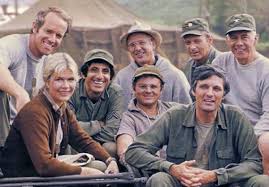
One of the longest-running and possibly the best-loved of all US TV sitcoms, it clearly hit a nerve in post-Vietnam America. It totally eclipsed the feature film on which it was based, which, being an Altman film, was episodic in nature with a large ensemble cast and thus the perfect basis for sitcom.
6: I Love Lucy (CBS, 1951-57)
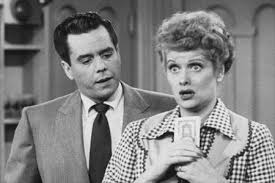
As important for the significance of its production and distribution models as for that of its content, I Love Lucy is undoubtedly the key title from the early years of television sitcom. It set so many conventions that it may itself look a little conventional in retrospect, but the quality of comic invention was uneven from episode to episode.
7: Cheers (NBC, 1982-93)

The best ensemble cast of all – many prominent careers were launched from the Boston bar where everybody knows your name and the situation was so strong that it could easily survive the departure of key cast members and re-invent itself. It’s spin-off, Frasier, itself became one of the key titles of the 1990s.
8: Black-ish (ABC, 2014-)

The real breakthrough for the portrayal of African Americans in TV sitcom. Yes, The Cosby Show pre-dates it by three decades, but that was essentially a conventional comedy which only differed from those around it because of the colour of the faces and only rarely tackled issues pertaining to the black community. Black-ish puts those issues at centre stage and builds its comedy deftly around them, while at the same time presenting, as Cosby did, a traditional sitcom family of likeable characters.
9: The Dick van Dyke Show (CBS, 1961-66)

Created by Your Show of Shows writer Carl Reiner and based on his experiences, The Dick van Dyke Show offered two sits for its com: domestic and workplace, the latter being the writer’s room of a TV sketch show. And it eagerly grabbed the myriad possibilities offered by both, being consistently funny and entertaining. Co-star Mary Tyler Moore went on to make her own highly significant contribution to the production of TV comedy.
10: Taxi (ABC, 1978-83)
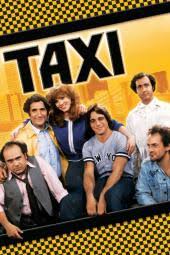
Second only to Cheers in the “great ensemble cast” stakes, this was an excellent example of the characters, rather than the situation, being the situation. The characters are trapped in a purgatory from which they can briefly emerge but to which they must always return. Great performances from Danny de Vito, Christopher Lloyd and the enigmatic Andy Kaufman.
As with my British list, I will also offer you my “next ten” (11-20), which also allows me to acknowledge some outright classics, some of which probably deserve to be higher and maybe would have been if I had seen more of them.
11: Master of None (Netflix, 2015-)
12: Mary Hartman, Mary Hartman (Filmways, 1976-77)
13: Soap (ABC, 1977-81)
14: Roseanne (Carsey-Werner, 1988-2018)
15: Better Things (FX, 2016-)
16: The Mary Tyler Moore Show (CBS, 1970-77)
17: The Larry Sanders Show (HBO, 1992-98)
18: Parks and Recreation (NBC, 2009-2015)
19: Frasier (NBC, 1993-2004)
20: Happy Days (ABC, 1974-84)
So, if I were to combine my British and American top tens to make a general sitcom list (there aren’t any from anywhere else in the world that would make it!), what would it look like? I think my top three US titles would replace my bottom three British ones, but I guess that only goes to show my personal bias and how unreliable this list is.
 Clement and La Frenais, Linehan and Matthews, and Barry Cryer. However, there is a glaring omission – even these luminaries have somehow managed to produce a top twenty sitcoms list containing nothing by the generally acknowledged masters of the genre – Galton and Simpson. This is not just an oversight – this is mind-bogglingly wrong.
 Comedy Lecture, Ben Elton made the case for the traditional sitcom, recorded in a television studio in front of a live audience, and argued that it is a classic genre which is nowadays looked down upon by devotees of newer forms of comedy, made on location without a laughter track. Now, I am probably one of those Elton is thinking about – most of my favourite TV of the past two decades (both British and American) has been half-hour shows which are ostensibly comedy, but which have a serious edge (sometimes a very serious edge). Some of them are made primarily for laughs, but some are not – some are closer to drama than comedy (and never mind the duration). Another thing that sets them apart is narrative development across episodes, whereas a traditional sitcom usually has self-contained episodes which could be shown in any order. There could certainly be a separate list of half-hour comedy-dramas, but it would contain mostly recent material. Perhaps that is one for the future, or perhaps some of the titles may belong on drama lists, but for the present I am going to include both traditional studio and modern single-camera sitcoms on my list, as did the Radio Times, because I can’t think of any better way to do it.

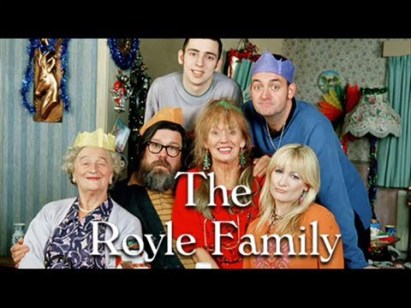


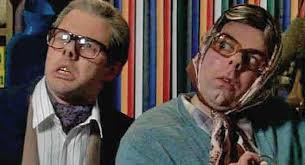


 Show in the USA; Hancock’s Half Hour in Britain. When the origins of the form are traced back beyond the start of the television era, the usual medium cited is radio, quite naturally as it is also a broadcasting medium. Numerous titles which became significant television sitcoms originated in radio and, in the US, the form can be traced back to the 1920s. For example, the notorious Amos ‘n’ Andy originated on radio in 1928, before being produced for television (interestingly enough, at the Hal Roach Studios) in the fifties. As the earliest sitcoms were performed for a studio audience, theatre, especially music hall, can also be regarded as an influence, but film is rarely considered, other than for the impact of one comedian’s work on another’s (and Stan and Ollie are regularly cited in this regard). However, I can see many things which became essential elements of television sitcom in the Laurel and Hardy shorts of the early thirties.
 65, 1970-74) is an interdependent father/son relationship in which the son feels trapped. It is not the rag and bone business – there are plenty of episodes in which that business plays no part whatsoever in the narrative. Throughout their short films, Stan Laurel and Oliver Hardy played highly recognisable and consistent characters and they developed depth to those characters as they continued to play them, much as happens in a successful long-running sitcom.
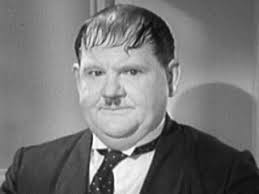 audience is also acknowledged in Ollie’s looks into the camera. And two male leads is very common in sitcom, particularly on British TV, which prefers its comedy characters to be losers & failures, rather than the wisecracking types more prevalent in the US – echoes of Laurel and Hardy can be found in the partnerships of Tony Hancock and Sid James, Steptoe and Son, The Likely Lads and more.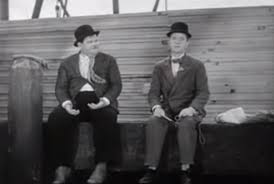
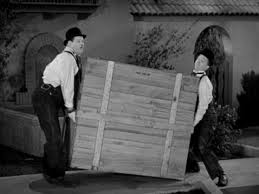 mess of them, much as Charlie Drake did every week in the 1960s sitcom The Worker (ATV, 1965-70). The films which fit this scenario are: Men O’War (1929); The Music Box (1932); County Hospital (1932); Towed in a Hole (1932); The Midnight Patrol (1933); Busy Bodies (1933); Dirty Work (1933): Going Bye-Bye (1934); Them Thar Hills (1934); The Live Ghost (1934); Tit for Tat (1935); The Fixer Uppers (1935). Them Thar Hills and Tit for Tat are especially interesting in that the latter sees the return of a couple, played by Mae Busch and Charlie Hall, whom Stan and Ollie first encounter in the former, and the script makes specific reference to the connection, as regularly happens in serial sitcoms.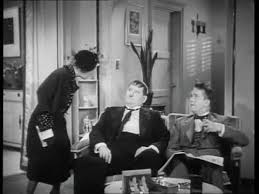
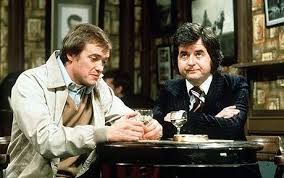 (BBC, 1973-74), which was a continuation of The Likely Lads (1964-66) itself comparable to the earlier Laurel and Hardy “situations”. The films are: Unaccustomed as We Are (1929); Hog Wild (1930); Our Wife (1931); Helpmates (1932); Their First Mistake (1932); Me and My Pal (1933); Oliver the Eighth (1934); Thicker Than Water (1935).
 of Be Big and regarded as probably the best of their longer films, also fits here (another “special”?). In Brats, Laurel and Hardy play their own children (the final development?) and in Twice Two, their own sisters (and each other’s wives). A further flaw to my theory is that, in both the final two situations, the actresses playing the wives differ from film to film, but similar cast changes are not unknown in sitcom and don’t forget that in real life Oliver Hardy was married three times, while Stan Laurel was married at various times to four different women, one of them twice!
 TV for Keeps