

Well, it was a wonderful TV year overall, that’s for sure, but, as I speculated in my blog of 17th July (A Year of Two Halves?), the second six months could not hope to compete with the astonishing quality of the first. January to June produced fifteen titles for my shortlist, but I have only so far added a further two in the months since, both of them from streaming platforms (and both Netflix), which seem to release their best stuff in the run up to Christmas. Maybe the broadcasters have decided not to compete with this strategy, preferring instead to fill their schedules with an over-abundance of Reality TV at this time of the year.
Anyway, I can certainly add a third more recent title, with another streaming service (Amazon this time) having only just finished giving us one of the unmissable gems of the year – the final season of Sam Esmail’s Mr Robot. This has been a consistently wonderful series and received the concluding season and finale it deserved. I was particularly struck by Esmail’s use of a device very similar to that which illuminated the year’s  earliest masterpiece, Fleabag – whereby the central character’s fourth-wall-breaking habits (Fleabag’s looks to camera, Elliot’s narration) are challenged by another character (Fleabag’s love interest and Elliot’s doppelganger respectively) to unsettling effect. Indeed, the finale of Mr Robot was all about making us, the audience, complicit in the action. “Is this real” was the question constantly being asked by both the characters and ourselves and the only reliable answer must be “of course not – it’s a TV series”. At the end it didn’t matter how much of what we had seen had been a construct of Eliot’s mind, because it was wildly entertaining and engaging – just as a great TV series should be. I liked the nod to 2001: A Space Odyssey, too. Not just one of the year’s best, but one of the decade’s (and I’ll be back to that).
So, I have ended up with a top 18 this year, from which I have chosen the following top ten of 2019 (as usual, in rough order of their appearance and you will notice that 8 of them are from the first half of the year):
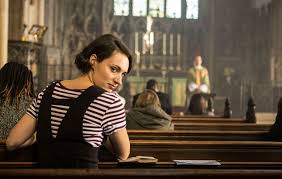
Fleabag (BBC1)
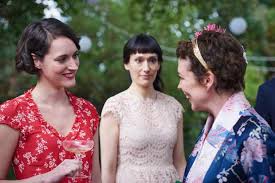
Just the two series and it’s all over, but the true genius knows when to call it a day and it went out on the highest of highs.
Janet Baker in Her Own Words (BBC4)

John Bridcut’s fitting and moving tribute to one of this country’s greatest and most distinctive singing voices
One Day in Gaza (BBC2)

A brilliantly constructed and presented documentary on a subject that is very raw and controversial – so much so that it is still to be seen in the USA, where it was jointly commissioned.
Mum (BBC2)

Another perfect piece which paced itself carefully towards a satisfying and emotional climax in its third series.
63 Up (ITV)

Hard to accept that this may be the last time we meet the characters whose lives we have followed since they were seven. Keep going, Michael Apted – we need them back in 2026.
Chernobyl (HBO/Sky Atlantic)

Hugely impressive, riveting and illuminating telling of the story of a nuclear disaster which could have been an international catastrophe.
Deadwood; the Movie (HBO/Sky Atlantic)
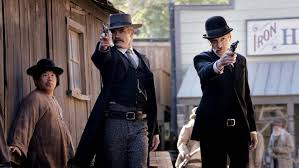
We thought this would be one of the great unfinished series, but David Milch managed to provide the perfect finale just in time.
The Virtues (Channel 4)
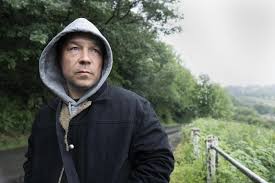
Searing and mesmerising three-parter from Meadows, Thorne and Graham – the most intense television of the year.
Top Boy (Netflix)
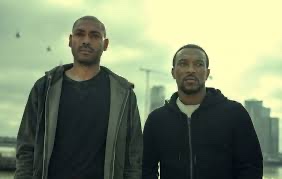
A very welcome return for Ronan Bennett’s’ urban epic, this time given the space to grow into something even more arresting
Mr Robot (Amazon)

The astonishing and satisfying final season of one of the decade’s greatest
Happy New Year everybody! I’ll be back early in the new one with my list of the best of the decade.
 (Sky Atlantic) and The Virtues (Channel 4), will indeed feature and very strongly so – both maintained the qualities I described to their respective ends and I think they are probably the two best drama series of the year so far. The Virtues provided an extended finale of even greater intensity than the episodes which led up to it, with the main plotlines leading to two simultaneous and harrowing confrontations with different, though unpredictable, outcomes (I won’t spoil it – do watch it if you haven’t already). And the extra information we were given during the end credit sequence of the final episode of Chernobyl was a devastating climax of its own – I’ve never seen that device used so effectively.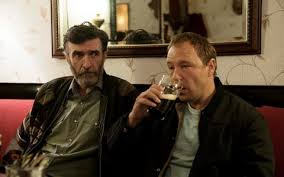
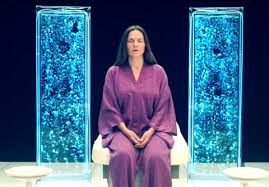 wired up to a mind-reading device in a futuristic scene reminiscent of Dennis Potter’s Cold Lazarus (BBC/Channel, 4 1996). And Anne Reid’s soliloquy about automated check-outs really hit a nerve – I always queue for the human-operated tills in my local Waitrose and refuse any offers to help me with the automated section – now I can say “didn’t you see Years and Years?” as well. If you look at it as political satire rather than drama, it has a much greater resonance.

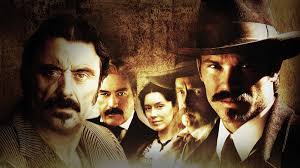
 children’s schedules (and my own viewing) when I first started watching TV in the late 1950s. ITV had just begun and imported a large number of American titles, with the BBC following suit to compete. My particular favourites were The Lone Ranger (ABC, 1949-57), Wagon Train (NBC, 1957-62), Maverick (ABC, 1957-62), Bonanza (NBC, 1959-73) and, above all, Rawhide (CBS, 1959-65). However, the genre all but disappeared from TV (and, indeed, the cinema) from the late sixties onwards. There were many reasons for this – socio-political, cultural and economic – though there were the occasional revivals in both cinema (mostly thanks to former TV cowboy Clint Eastwood) and TV (1989’s Lonesome Dove), but then nothing of real impact until….
 for so much of the f-ing and c-ing in the dialogue, but one which belonged to the real-life individual on whom the character is based. Indeed, most of the characters in Deadwood are based on the town’s original inhabitants and the narrative is closely tied to the historical reality and to examining the development of social, political and economic structures which emerged from the anarchy of the pioneering west; and within this narrative, Milch and his terrific cast create characters who have both a historic and contemporary resonance, which is why it works so well.
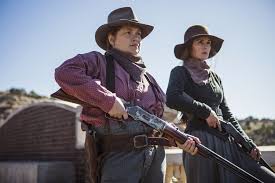 activities of the mineral pioneers, through the importance of the press in the development of the west and its mythology to the depiction of lesbian relationships. However, having watched it immediately after finishing Deadwood, its differences are more striking: it has much more in the way of open spaces, whereas Deadwood is almost completely confined to the town, which gives it a claustrophobic feel (rather like that of NYPD Blue); it also has more in the way of traditional western tropes (the “cowardly” sheriff redeemed at the end; the mysterious stranger who acts as a mentor to a young boy, before riding off into the sunset; a climactic shootout worthy of Sam Peckinpah) despite the “twist” that it features a large number of female protagonists; basically it looks like an extended movie rather than a TV series (shot in a 2.39:1 ratio; complete at just over 7 hours, or less than twice the running time of Heaven’s Gate). It is also mightily impressive and enjoyable and a significant addition to the western canon on both film and TV.
 TV for Keeps