

Well, it was a wonderful TV year overall, that’s for sure, but, as I speculated in my blog of 17th July (A Year of Two Halves?), the second six months could not hope to compete with the astonishing quality of the first. January to June produced fifteen titles for my shortlist, but I have only so far added a further two in the months since, both of them from streaming platforms (and both Netflix), which seem to release their best stuff in the run up to Christmas. Maybe the broadcasters have decided not to compete with this strategy, preferring instead to fill their schedules with an over-abundance of Reality TV at this time of the year.
Anyway, I can certainly add a third more recent title, with another streaming service (Amazon this time) having only just finished giving us one of the unmissable gems of the year – the final season of Sam Esmail’s Mr Robot. This has been a consistently wonderful series and received the concluding season and finale it deserved. I was particularly struck by Esmail’s use of a device very similar to that which illuminated the year’s  earliest masterpiece, Fleabag – whereby the central character’s fourth-wall-breaking habits (Fleabag’s looks to camera, Elliot’s narration) are challenged by another character (Fleabag’s love interest and Elliot’s doppelganger respectively) to unsettling effect. Indeed, the finale of Mr Robot was all about making us, the audience, complicit in the action. “Is this real” was the question constantly being asked by both the characters and ourselves and the only reliable answer must be “of course not – it’s a TV series”. At the end it didn’t matter how much of what we had seen had been a construct of Eliot’s mind, because it was wildly entertaining and engaging – just as a great TV series should be. I liked the nod to 2001: A Space Odyssey, too. Not just one of the year’s best, but one of the decade’s (and I’ll be back to that).
So, I have ended up with a top 18 this year, from which I have chosen the following top ten of 2019 (as usual, in rough order of their appearance and you will notice that 8 of them are from the first half of the year):
Fleabag (BBC1)
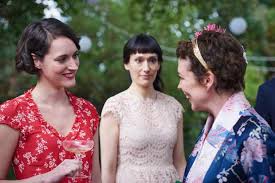
Just the two series and it’s all over, but the true genius knows when to call it a day and it went out on the highest of highs.
Janet Baker in Her Own Words (BBC4)

John Bridcut’s fitting and moving tribute to one of this country’s greatest and most distinctive singing voices
One Day in Gaza (BBC2)

A brilliantly constructed and presented documentary on a subject that is very raw and controversial – so much so that it is still to be seen in the USA, where it was jointly commissioned.
Mum (BBC2)

Another perfect piece which paced itself carefully towards a satisfying and emotional climax in its third series.
63 Up (ITV)

Hard to accept that this may be the last time we meet the characters whose lives we have followed since they were seven. Keep going, Michael Apted – we need them back in 2026.
Chernobyl (HBO/Sky Atlantic)

Hugely impressive, riveting and illuminating telling of the story of a nuclear disaster which could have been an international catastrophe.
Deadwood; the Movie (HBO/Sky Atlantic)
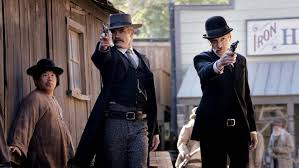
We thought this would be one of the great unfinished series, but David Milch managed to provide the perfect finale just in time.
The Virtues (Channel 4)
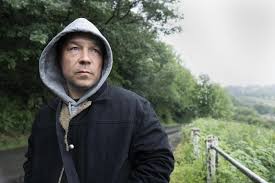
Searing and mesmerising three-parter from Meadows, Thorne and Graham – the most intense television of the year.
Top Boy (Netflix)
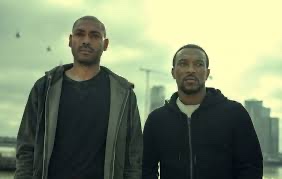
A very welcome return for Ronan Bennett’s’ urban epic, this time given the space to grow into something even more arresting
Mr Robot (Amazon)

The astonishing and satisfying final season of one of the decade’s greatest
Happy New Year everybody! I’ll be back early in the new one with my list of the best of the decade.
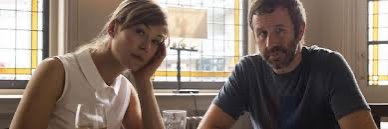
 in the tradition of pieces like Hugo Blick and Rob Brydon’s Marion and Geoff (BBC: 2000-2003) or Alan Bennett’s Talking Heads (BBC: 1988, 1998). The details of the characters’ lives emerged gradually and as much by implication as by direct statement. This requires clever writing, great acting skills and subtle direction – Frears highlighted the more serious moments with the minutest of camera movements. Another outstanding two-hander, Louis Malle’s My Dinner with Andre (1981), is a valuable reference-point. Each episode included the week number (Week 1, Week 2 etc) in its title, so I watched them a week apart, not in twos, as they were transmitted, or by bingeing the whole 100 minutes on i-Player, as I’m sure many did, and I somehow think that was right. I imagine it will be back for another season and could well run and run.
 playing the “criminals” being interrogated in each episode. Each investigation is a separate story, but there is a story arc across the three episodes involving the police characters. Unfortunately, the lack of back-story context or characterisation in the criminal stories is a hindrance, so there is no great tension in the interrogation scenes, compared to Line of Duty (or even 24 Hours in Police Custody). I haven’t watched every national version, so one of them may have cracked the format, but on the evidence I have seen (the UK and German series), I doubt it.
 examples – most prominently in this season, the Atlanta child murders). What is discussed is grisly in the extreme and comes across far more shockingly for being dispassionately spoken about than it would do if recreated for the drama. The private lives of Bill Tench (Holt McCallany) and Wendy Carr (Anna Torv) impact strongly on the narrative and the way the characters’ private experiences are shown to inform their innovative behavioural research (and vice versa) reminded me of a previous series: Masters of Sex (Showtime, 2013-16).
 (Netflix). Having provided Channel 4 with two outstanding 4-part series in 2011 and 2013, Ronan Bennett’s Top Boy was then inexplicably dropped. But now, thanks to interest (and finance) from the rapper Drake, it is back on Netflix with a new 10-part season and the promise of more to come – and this is very good news. And the fact that the series has been so greatly expanded allows for many more back stories and for reflection on the circumstances the characters find themselves in – all of it highly pertinent to the recent rise in street crime and the headlines it has made.
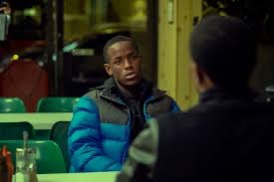 complete a trio of riveting protagonists. Writing and direction are top-notch throughout, as is the music – both the original score by Brian Eno and the rap music which provides both impetus and comment. A key theme is the tension between the main characters’ involvement in drug wars and their attempts to engage in “normal” personal lives and look after family members, as well as the inevitable impact of the gang scene on the youngest members of the community. In this respect, it echoes The Godfather films in its epic scope.
 TV for Keeps