


No programme-maker is more in touch with the wonder and the rhythms of infancy, nor is better able to express that wonder and those rhythms in audio-visual terms than Andrew Davenport. As a constant viewer of CBeebies with my daughter Hanna (as I have explained previously), I have been fortunate to have been immersed in his world and to have appreciated just what a brilliant and innovative contribution to the genre of  preschool television he has given us with the three shows he has created over the past two decades, the latest of which arrived in February. But he is not only the creator – he produces, writes and composes the music for each episode.
There is no doubt that his greatest impact was with Teletubbies (BBC2, CBeebies, 1997-), which changed the landscape of what was possible in a programme for very young children. There was plenty of controversy about it: the limited language which mimicked that of very young children perfectly, but was criticised for normalising it at a time when the main function of such programmes was meant to be education and progression; the generally surreal setting and atmosphere which led some to wonder whether the makers were on drugs and attracted a cult 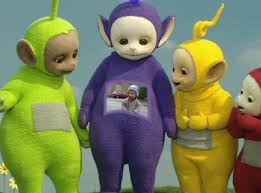 student audience; even Tinky Winky’s sexuality! But its main and greatest innovation was repetition. This applied not only to the filmed stories of different children’s lives which appeared on the Teletubbies’ stomach monitors and which they immediately demanded to be repeated in full, but to segments of the show itself – dances, adventures, domestic life in the Teletubby house, which could be shuffled around to comprise parts of different editions.
Teletubbies starts with a sunrise and ends with a sunset, so each episode takes place over the course of a day, but Davenport’s next creation, In the Night Garden (CBeebies, 2007-) begins with a small child (a different one for each episode) in bed and being coaxed to sleep with a story, so it can best be interpreted as a dream (as the title suggests). It is a very beautiful and comforting beginning, which is probably more emotionally resonant for any watching adults than children. Once the dream world of the night garden has been reached, the stars in the sleepy night sky having bust into the flowers of the bright garden, familiar characters arrive and have various adventures, all of them once again interchangeable from episode to episode.

Where Teletubbies was hallucinatory and surreal, In the Night Garden seems to be exploring the world of the early subconscious, and Davenport has taken this further with his new series, Moon and Me (CBeebies, 2019-). Again it starts with a child preparing for bed, this time by closing down the dolls’ house she has been playing with and putting her toys to bed, but now it is the same little girl every time and the similarity of their hairstyles indicates that her favourite toy, Pepi Nana, is her surrogate once she has gone to sleep and the toys have come to life. So, it can again be interpreted as her dream, though the Storyland sections indicate that it may also be a bedtime story. CBeebies’ scheduling of the series at 5.45 backs this up, though In the Night Garden retains its 6.30 bedtime slot.
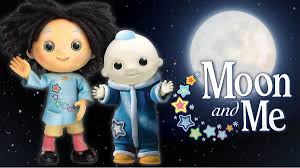
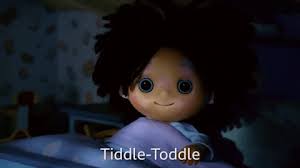
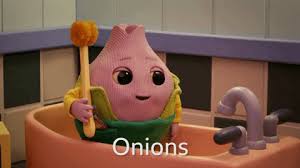
The similarities between the characters In Moon and Me and In the Night Garden are also obvious – Pepi Nana is like Upsy Daisy, Collywobble resembles Makka Pakka. My favourite has to be Mr Onion, who constantly says “onions” with a chuckle in his voice. Indeed, all the characters have their own catchphrases, which they repeat ad nauseam, though with variations of tone and stress to indicate attitude; Pepi Nana has a multitude of different ways of saying “tiddle toddle”. Mind you, having spent the last weeks (months!) listening to the same politicians saying precisely the same things about Brexit over and over again, day after day, this is clearly not confined to the world of pre-school television.
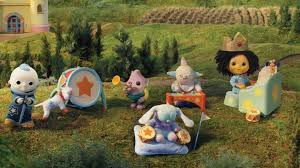
One striking difference between Moon and Me and Davenport’s two previous series is the use of colour; muted pastel shades replacing bright primary colours, even in the pastoral Storyland, which has echoes of both Teletubbyland and the Night Garden. Davenport’s music is again a major factor, in fact even more so this time as it is integrated by having the characters play their own instruments: Moon Baby’s hand harp is key. The narration is consequently less important than in the Night Garden, where Sir Derek Jacobi’s actorly tones are so perfect for the nonsense rhymes he is asked to recite:
Ombliboo, Tombiboo, knock on the door.
Ombiiboo Tombliboo, sit on the floor.
Ombliboo, Tombliboo, here is my nose.
Ombliboo, Tombliboo, that’s how it goes.
The characters in Moon and Me are animated to move the way they would if a child was playing with them; just watch the way Little Nana moves up and down as though being picked up and placed down. There is no tea in the teapot or cups, but they are moved just as if a playing child were moving them. Davenport did a lot of research on play patterns 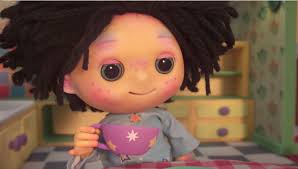 to get this right. When Pepi Nana comes downstairs, or crosses a bridge, you see her do it in real time, or, through clever editing including the beginning and end of the journey, the complete process of the action is conveyed so that it seems it has been shown in full. This is a style associated with the great French director Robert Bresson, and Davenport also uses close ups of characters’ hands or feet in a similar way to Bresson. (Is that comparison worthy of Pseud’s Corner or what?) The overall effect is a feeling of immersion – the sort you get from listening to minimalist music or watching a piece of “slow TV” like The Canal Journey. It is very relaxing and reassuring.
I hope this may inspire you to watch the odd episode or two of Moon and Me, even if you don’t have a pre-schooler to watch it with. It would be twenty minutes of your time well spent on the BBC i-Player. Both Moon and Me and In the Night Garden work for adults who may like occasionally to regress to the world of infancy, not as any sort of perversion, but as a relaxing break from the ugliness of so much everyday public discourse.
Tiddle toddle! Poop poop!
Onions.
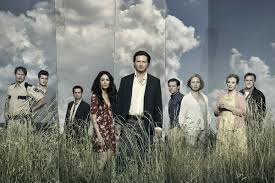
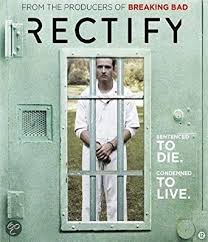 effects of his release on his family (including his new step-family) and on the small Georgia community he returns to. The question of his guilt or otherwise, and who else may have committed the crime, is a secondary concern – indeed, the suicide of another suspect at the very start of the first season sets up the possibility of a new investigation, but his body is not discovered until the very end of the second season, at which point that angle of the plot can be advanced. In the meantime, Daniel’s presence is a cause of great discomfort and divisiveness to many. The fourth season is about coming to terms with misfortune and injustice, not just for Daniel, but for many of the characters, as well as being about solving the case – and in the end it is more important for it to be established that Daniel didn’t commit the crime than to find out who did.
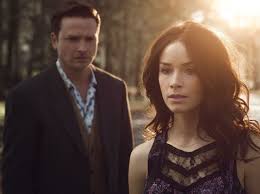 live and is more at ease in the flashbacks to his time on death row, to which he retreats as an escape from the stresses of freedom. Aden Young’s performance is very low key and understated – he speaks quietly and chooses his words carefully, but you can sense the inner turmoil at all times. At the same time, his brooding presence forces the other characters to reassess their own lives and problems. This extends eventually also to the legal and political authorities, gradually coming to terms with the nature of their mistakes, and to the family of the victim in terms of their misapprehensions.
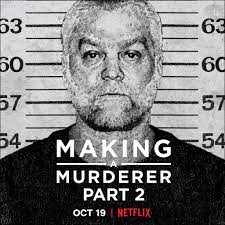 divided over a shocking crime; a miscarriage of justice involving an imprisonment of almost 20 years; the release of a convicted man on new DNA evidence, but continuing doubts about his guilt; unreliable confessions; the iniquity of the plea bargaining process; machinations between police, legal and political authorities; the slowness of the legal system to provide redress; above all, the focus on who didn’t commit the crime rather than who did. It is not surprising that the overturning of convictions through new DNA evidence should give rise to both dramatic and documentary treatment. However, the two pieces have many stylistic as well as thematic connections – just look at the similarities, both visual and musical, in the opening title sequences. Drama and documentary now feed off each other in the era of cinematic television.
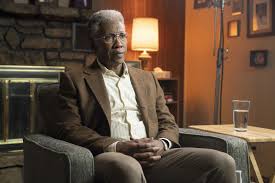 there are references back to two time periods, 15 and 25 years previously, when a case of child murder and abduction seemed to have been solved and then re-solved by the same two detectives, though it turns out they were taking the easy option to close the case on each occasion. The new investigation is prompted by a present-day documentary team making a series on the case (in the style of Making a Murderer, of course), which was both a local trauma and the subject of a sensational book by the wife of the lead detective. The narrative is further complicated by the fact that the detective in question (played by Mahershala Ali) is suffering from the early stages of dementia, so that his memories may not all be reliable. Time is frequently folded in clever scene changes.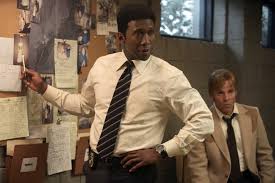

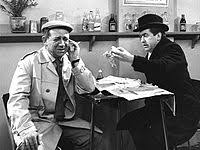 Show in the USA; Hancock’s Half Hour in Britain. When the origins of the form are traced back beyond the start of the television era, the usual medium cited is radio, quite naturally as it is also a broadcasting medium. Numerous titles which became significant television sitcoms originated in radio and, in the US, the form can be traced back to the 1920s. For example, the notorious Amos ‘n’ Andy originated on radio in 1928, before being produced for television (interestingly enough, at the Hal Roach Studios) in the fifties. As the earliest sitcoms were performed for a studio audience, theatre, especially music hall, can also be regarded as an influence, but film is rarely considered, other than for the impact of one comedian’s work on another’s (and Stan and Ollie are regularly cited in this regard). However, I can see many things which became essential elements of television sitcom in the Laurel and Hardy shorts of the early thirties.
 65, 1970-74) is an interdependent father/son relationship in which the son feels trapped. It is not the rag and bone business – there are plenty of episodes in which that business plays no part whatsoever in the narrative. Throughout their short films, Stan Laurel and Oliver Hardy played highly recognisable and consistent characters and they developed depth to those characters as they continued to play them, much as happens in a successful long-running sitcom.
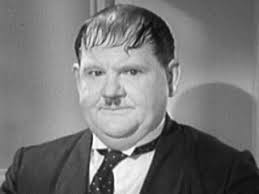 audience is also acknowledged in Ollie’s looks into the camera. And two male leads is very common in sitcom, particularly on British TV, which prefers its comedy characters to be losers & failures, rather than the wisecracking types more prevalent in the US – echoes of Laurel and Hardy can be found in the partnerships of Tony Hancock and Sid James, Steptoe and Son, The Likely Lads and more.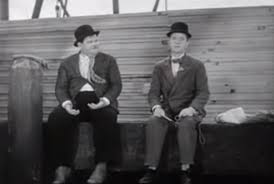
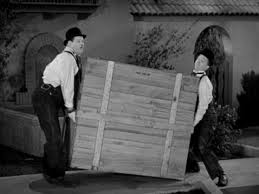 mess of them, much as Charlie Drake did every week in the 1960s sitcom The Worker (ATV, 1965-70). The films which fit this scenario are: Men O’War (1929); The Music Box (1932); County Hospital (1932); Towed in a Hole (1932); The Midnight Patrol (1933); Busy Bodies (1933); Dirty Work (1933): Going Bye-Bye (1934); Them Thar Hills (1934); The Live Ghost (1934); Tit for Tat (1935); The Fixer Uppers (1935). Them Thar Hills and Tit for Tat are especially interesting in that the latter sees the return of a couple, played by Mae Busch and Charlie Hall, whom Stan and Ollie first encounter in the former, and the script makes specific reference to the connection, as regularly happens in serial sitcoms.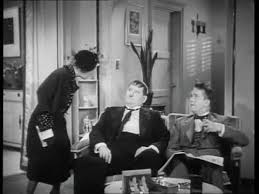
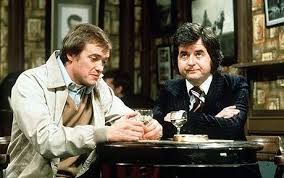 (BBC, 1973-74), which was a continuation of The Likely Lads (1964-66) itself comparable to the earlier Laurel and Hardy “situations”. The films are: Unaccustomed as We Are (1929); Hog Wild (1930); Our Wife (1931); Helpmates (1932); Their First Mistake (1932); Me and My Pal (1933); Oliver the Eighth (1934); Thicker Than Water (1935).
 of Be Big and regarded as probably the best of their longer films, also fits here (another “special”?). In Brats, Laurel and Hardy play their own children (the final development?) and in Twice Two, their own sisters (and each other’s wives). A further flaw to my theory is that, in both the final two situations, the actresses playing the wives differ from film to film, but similar cast changes are not unknown in sitcom and don’t forget that in real life Oliver Hardy was married three times, while Stan Laurel was married at various times to four different women, one of them twice!

 aspects of my all-time favourite American comedy series, Curb Your Enthusiasm: the central relationship of a performer and his agent; their bemusement at the ways of the modern world; the showbiz milieu, with guest stars playing either characters (Danny de Vito, Ann-Margret) or themselves (Jay Leno, Elliot Gould); the strong Jewish humour. It’s not earth-shattering, but it has its moments of reflection and is extremely watchable.
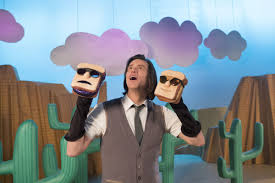 lists, as it probably should have. It is visually striking (full of bold colours), with an occasionally unnerving narrative, which veers from comedy to tragedy in the blink of an eye and centres on a group of people involved in the production of a Sesame Street-like children’s TV show, while at the same time dealing with personal loss and life challenges. Carrey is perfectly cast as the insecure star, Mr Pickles, constantly wanting to introduce themes of death into his character’s show. It was a slow starter and took some getting used to, but the later episodes were very memorable and I will certainly be returning to it.








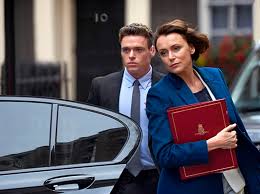 after four episodes – after a very promising start, it seemed to be drawing the story out to intolerable lengths: maybe I’ll give the Ridley Scott movie a go instead. Bodyguard gripped to the end but was ultimately just too improbable and manipulative for my taste (and how was the dead man’s button ever a problem when his hand was taped to the device?). No Offence was its usual wonderful self, but I don’t think the third season represented any kind of advance on the previous two, so it doesn’t make it to the shortlist for that reason.
 the standard of some of the later episodes did not reach her level. Also, it settled into a regular, episodic and repetitive game of cat-and-mouse, which would have been fine if it had come up with a satisfactory ending but leaving things open for a second season was precisely not what I wanted (in that respect it reminded me of The Fall). I won’t be following it further.
 maybe that is just because his style is established and no longer such a revelation. Nevertheless, it still resonates with me and definitely needs to be revisited. It was also remarkable for treating a period of recent African history at length and with little concession to western ignorance, while at the same time providing a lot of great roles to black acting talent.
 shifted it from an interesting and engaging comedy-drama about sex and relationships to something with considerably more depth, so it is there. Once Bodyguard was over, I carried on watching whatever drama tuned up in the BBC1 Sunday night 21.00 slot – The Cry was highly involving and well-constructed over 4 episodes, but The Little Drummer Girl fell between two stools of Le Carre adaptations, with neither the Bond-ish glamour of The Night Manager or the claustrophobic intensity of the Smiley series, and I gave up after two episodes (I like to think I’m getting good at spotting the duds early and subsequent feedback seems to confirm a wise choice in this case).
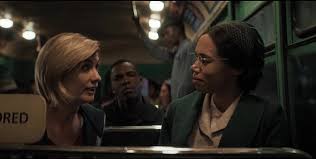 made it so seamless. Even the move to Sunday night has worked better than I predicted, but I still prefer stories which take more than one episode and miss both the cliff-hangers and the pre-credit sequences, which seem to have been dispensed with. The most significant thing about Chibnall’s approach for me, though, is how it looks back to Sydney Newman’s original 1963 conception of the series as a vehicle for historical education (before Verity Lambert introduced the Daleks in the second story and set it firmly on the sci-fi path). In particular, the episode about Rosa Parks has to be the purest manifestation of Newman’s original vision the series has achieved in its 55-year history. The episode did have sci-fi elements, including an agent sent from the future to alter history, but programmed not to kill (nods to both Terminator 1 and 2 there!), but it did not flinch from a fine examination of the historical context of the civil rights movement, which was a great lesson for the character of Ryan as well as the young Doctor Who audience of today. I am thus including that particular episode in my shortlist for the best of the year.
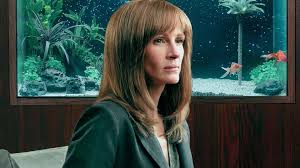 what had happened and the crisis point is approached gradually from both directions. The future scenes are shot in a restrictive, claustrophobic frame, while the full-frame scenes include split screen sequences and, together, the shooting styles represent a very clever way of advancing the narrative. The series contains what has to be my “TV moment of the year” (big spoiler alert here, if you haven’t seen it!): at the moment when the future Heidi realises the truth of what happened the restricted screen expands into full widescreen – which sounds trite when I write about it but is a stunning effect when you watch it. The ending of Homecoming is also very satisfying but is not the ending – you have to sit through the entire and lengthy end credits (which I always do) to get to an extra scene which sets up a second season. Very neat! (makers of Killing Eve etc. take note!). It’s the best thing on Amazon since…well, since Mr Robot, and a must for the shortlist.


 Comedy has regularly used the adult “simpleton” as a staple character and a source of (often cheap) laughs. Some performers created comic personas which can only be understood as adults with (usually mild) learning disabilities – Jerry Lewis and Norman Wisdom spring to mind. The character of Frank Spencer in Some Mothers Do ‘Ave ‘Em (BBC, 1973-78) falls into this tradition and even the person I regard as the greatest comic genius of the 20thcentury, Stan Laurel, is not entirely immune from inclusion in this list. The only comedy character I can recall whose learning disability was acknowledged was Dennis Dunstable in LWT’s Please, Sir (1968-72). However, I should also mention in this context Caroline Aherne and Craig Cash’s wonderful Mrs Merton and Malcolm (BBC, 1999) in which Malcolm’s learning disability was not acknowledged, even though that is the only credible explanation for the character. Described by Time Out (!) as “possibly the most disturbing show on television”, it only ran for one much misunderstood series.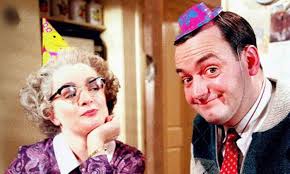

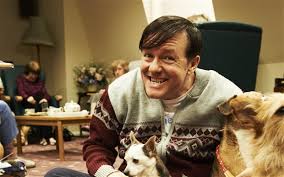 generally conclude that Derek is the one who has things figured out, because he is always so cheerful. That helped me to change my own feelings about Hanna’s condition from one of regret that she will never have a “normal” life to one of acceptance and even gladness that her constantly happy attitude will persist. When you have no concept of what your life could have been, you will have little experience of disappointment, so it should not be a cause for regret. It is possible that this attitude of mine is something of a cop-out for my own peace of mind, but it works for me: besides which, ensuring that she continues to have the appropriate secure environment is enough to keep me occupied. As for Derek, it is also a good example of the sort of series I referred to at the start of this blog – one for which my enthusiasm is engendered by personal connection but is out of step with the general critical consensus.
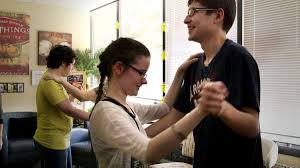 satisfactory independent life for her disabled daughter – a problem she remarkably solved by outliving her. One of my favourite recent documentaries is How to Dance in Ohio (HBO, 2015) which was about the organisation of a formal prom for a group of autistic youngsters – it was emotional and inspirational, and I certainly recognised my own life in it from accompanying Hanna to the school and college proms and discos which she loves.
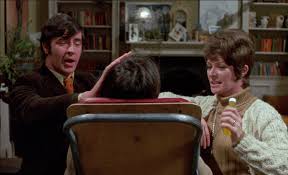 stage play which had both film and television adaptations. It has a similar dark humour to There She Goes and was also based on the writer’s own experiences, but it dates from an era when disability was more a private affair and the girl’s disability is severe cerebral palsy. There She Goes is pretty much contemporary to our own experiences and also features a child with undiagnosed disabilities similar to Hanna’s, though a little more severe and much more disruptive.
 at work while she had to cope with her worries about Hanna in isolation, so it was very hard for her to watch this and Pye (a writer on Have I Got News For You – my favourite comedy panel show) wisely sought his own wife’s input for the character of Emily, which meant it was spot-on. One flashback scene struck me particularly, because it contained a piece of dialogue which came pretty much verbatim out of my own mouth back in about 2003: after a visit to our excellent consultant neurologist, who was organising all sorts of tests for Hanna, none of which produced a conclusive diagnosis, I wondered aloud whether he was partly motivated by the possibility of getting a syndrome named after himself, as does Simon.
 timeframe was the ideal length for the sort of observational pieces it featured. At the same time, subjects requiring lengthier treatment, such as the history of western civilisation or World War II, were organised into series, while investigative work was the province of current affairs programming or special strands like Pilger (ITV). Lengthier single documentaries tended to remain the province of the cinema, and of master film makers like Fred Wiseman or Marcel Ophuls, but they were rare, while Werner Herzog and his American protégé Errol Morris kept the shorter cinematic non-fiction form alive.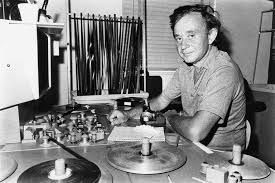
 their welcome and stretched their material beyond its optimum timeframe. Far too few displayed the kind of economy which had previously been seen as a virtue – one of my favourite documentaries of recent years was Kyoko Miyake’s 2014 production Brakeless, which considered all aspects of a disastrous Japanese train crash, investigated its causes, explained it in historical and industrial contexts, explored its impact on survivors and relatives and confronted those responsible: every angle being given due and adequate attention and the whole thing being wrapped up in under an hour.
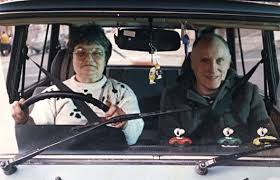 Driving School (BBC, 1997), but the style was not completely new – Paul Watson’s The Family (BBC, 1974), one of the most famous “fly on the wall” documentaries, anticipated it by a quarter of a century. But the big difference was that The Family was made on film. The introduction of lightweight video cameras in the 1980s, which had such a massive impact on news and current affairs, did not immediately impact documentary, which, as prestige authored production, continued mostly to use film, but when video became the norm for documentary, firstly in the era of docusoap and then for the so-called “fixed rig” programmes, the impact was massive.
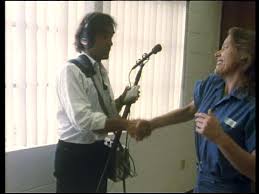 project. If something had been paid for, something had to be delivered and broadcast. Too many times I have sat through documentaries which have set out to investigate an individual or a situation but have become about the failure of the film makers to do so. Only Nick Broomfield, who invented the style, or Michael Moore can really get away with this, because their documentaries are more about themselves than their subjects.

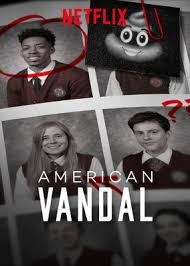
 good, if not even better than season one (though you can never replicate that first feeing of excitement about something truly original). Firstly, it is, as before, very much more than just a parody – once again you get involved with the characters as if it was a straight drama, and this time round there are many more of them, all brilliantly written and portrayed. Secondly, there are more issues being explored, particularly around class and race, and more documentary styles being invoked than just the crime investigation genre, which remains the basis – I could find echoes of such pieces as Mea Maxima Culpa, O.J.: Made in America and Catfish, as well as numerous pieces investigating the background to school shootings. The series even reaches a somewhat sobering and entirely serious conclusion about the lives of adolescents in the era of social media.
 indulgent fun with this. And, while the genres used – gangsters, sci-fi, medieval fantasy and so on – were clearly signposted, I was also aware of too many other styles and tropes employed in recent series: a bit of Mr Robot here, a bit of Fargo there and a bit of The Leftovers everywhere (the series was created by Leftovers writer Patrick Somerville, which was one of the main things that drew me to it in the first place). The main problem was one of balance: while episode one provided an intriguing and involving opening and episode 10 gave us a moving and satisfying conclusion, everything in between was devoted to the drugs trials and fantasy sequences. It was entertaining enough to keep me watching to the end, but I finished up wondering why.
 Sunday (2002) and United 93 (2006), he has now completed a trilogy of drama-documentaries about horrific events of such magnitude that they are known by the day or date on which they occurred. His cast of Norwegian actors, all speaking English, is quite remarkable – I don’t know how it has gone down in Norway, but it is testament to the power of the direction that this anomaly simply does not register.

 unfussy visuals; characters whose opinions and motivations evolve gradually; subtle yet powerful acting performances (Anna Maxwell-Martin, Daniel Mays, Vicky McClure). It ensured that all voices from the era of the Troubles were heard and understood, much as the Vanessa Engle documentary I highlighted from earlier in the year, The Funeral Murders, did. Indeed, the two pieces form a valuable diptych and, though they address issues from 25 and 30 years ago, have a similar contemporary resonance in reinforcing why the Irish border is the most important aspect of the Brexit process. Mother’s Day becomes the 9thprogramme on my running shortlist for the best of 2018.
 to any that do at that point. First to arrive, and now nearing completion, was Jed Mercurio’s Bodyguard (BBC1, Sundays), an accomplished thriller (as one would expect from that source) which has been a big success and even had the confidence to kill off one of its lead characters halfway through and thus wrong-foot the audience, as it seemed to have been developing a compelling conflict-of-loyalty theme which is now redundant. It is manipulative and at times stretches credibility, but I’m hooked on it.
 performances and the direction. The expansion of the narrative into the relationships of other characters (the couple’s friends, colleagues and children; Joy’s clients in her work as a therapist) is also highly engaging, but I did start to worry that it is beginning to stray into Cold Feet territory, potentially replicating the longevity and eventual repetitiveness of that series, so I’m not sure of the need to stay with it, but I probably will because: a) it’s as easy to watch as Cold Feet; and b) I’m still watching Cold Feet!
 since it was announced some three years ago) arrived on BBC2 last Monday. Black Earth Rising is the latest piece from my favourite television auteur, Hugo Blick (actually there aren’t many writer/director/producers around – Poliakoff is another, but they are few on the ground). If it turns out to be anywhere near as good as The Shadow Line (2011) or The Honourable Woman (2014), and early indications are that it will, then it will be an automatic choice for my top 10, but I will return to it later. So far it has contained Blick’s trademark expository scene-setting and has certain similarities to The Honourable Woman, but neither of these are particular drawbacks for me – it’s just great to be back in his intelligent and stylish world.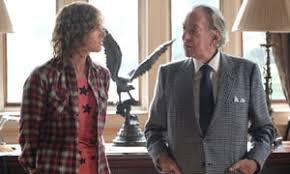
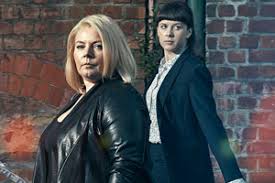
 Sunday evening. Moving it away from its traditional Saturday home has been tried before and it failed miserably, though maybe in the era of catch-up services it will not matter so much. I worry that the bold experiment of a female Doctor, already tied to the success or otherwise of a new and potentially uncertain show-runner, will be fatally compromised by this blunder – or maybe it is a way of giving the traditionalists something else to focus on, rather than the gender of the lead actor, thus diverting attention from the biggest change and providing something easily rectified. We shall see.
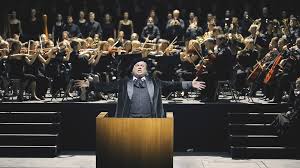
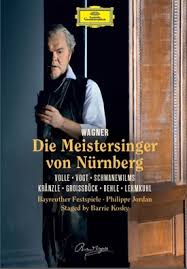 production of Die Meistersinger von Nurnberg. Not only was this a welcome opportunity to experience a very new and exciting production, but it is available at a rock-bottom bargain price (still under £15 last time I looked) and, when you consider that a ticket to see it in the Festspielhaus, if you were lucky enough to get one, would set you back upwards of two hundred (plus, of course, the cost of getting and staying there) the importance of such recordings being released is clear. Incidentally, though I hate to hear productions or performances being booed, the astronomical cost of attendance does make it a little bit understandable if someone feels they have been short changed.
 guests are given roles while other characters emerge (many in full reformation-era costumes, based on Durer) from his piano. Wagner himself plays Sachs (of course), though Walther and David clearly also represent himself at different stages of his artistic development, which fits perfectly with the theories of art he is exploring, as well as his own vanity. Cosima plays Eva, while her father, Franz Liszt, plays … her father. The Jewish conductor, Hermann Levi, is cajoled into the role of the comic villain Beckmesser, much as he had to endure Wagner’s antisemitism in order to be an important part of his artistic endeavour. The effect of this is to allow the director to explore issues raised by and concerning the work while not, as often happens with high-concept productions, working against what the music and the words are telling us – everything fits perfectly. The singers are historic characters playing operatic characters and are thus able to play those (operatic) characters much as they may in a conventional production.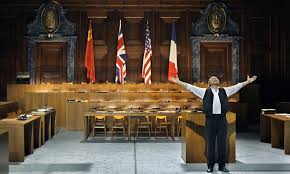
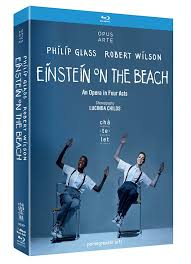 operatic creation in the 20thcentury, and the 2012 touring revival, which I saw at the Barbican, was essentially the same thing as first seen in 1976. That production (recorded in Paris and released by Opus Arte) has been available on Blu-ray since late 2016 but somehow the sophisticated algorithms employed by Amazon and others failed to notify me, despite the internet knowing full well that I am a big Philip Glass fan. I had assumed it would remain an unforgettable theatrical experience only and was delighted to find otherwise.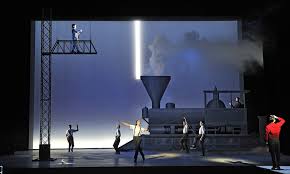

 TV for Keeps